";}
Monthly Archives

Sensory processing disorder

What Is SPD & How Sensory Therapy Can Change Everything

By | Blog | No Comments

Picture this: your child walks into a birthday party, hears the music, feels the crowd, smells the cake, and completely falls apart. Or maybe they’re the child who seeks every sensation: spinning endlessly, crashing into furniture, mouthing everything in sight. You’re not imagining things.

You’re not doing anything wrong. And your child is not being dramatic.

What you may be seeing is a nervous system that is working incredibly hard to make sense of a world that feels too much, or not enough. That’s Sensory Processing Disorder (SPD) in action, and it is far more common than most parents realize.

This blog breaks down what sensory integration actually means, how SPD shows up in children (especially those on the autism spectrum), and how sensory therapy, combined with the right support, can make everyday life dramatically more manageable.

And yes, we’ll tell you exactly how Early Autism Ventures fits into this picture. Buckle up.

What Is Sensory Integration, And Why Does it Matter?

Sensory integration is the brain’s ability to receive, organize, and respond to information coming in through the senses. Not just the five senses you learned in school, but eight. Yes, eight. In addition to sight, sound, smell, taste, and touch, the brain also processes:

  • Proprioception: the sense of where your body is in space (how hard to push, how high to jump)
  • Vestibular: the sense of balance and movement, seated in the inner ear
  • Interoception: the sense of internal body signals (hunger, thirst, pain, temperature, or needing the toilet)

When the brain processes all of these inputs smoothly, a child can pay attention in class, navigate a playground, tolerate a noisy lunch hall, and transition between activities without a meltdown. When it doesn’t, that’s where things get complicated.

The framework of sensory integration was pioneered by Dr. A. Jean Ayres, an occupational therapist and neuroscientist, in the 1970s. Her groundbreaking work, published in Sensory Integration and Learning Disorders (1972), laid the foundation for how we understand and treat sensory processing difficulties today.

So, What Exactly Is Sensory Processing Disorder (SPD)?


Sensory Processing Disorder (SPD) is a neurological condition in which the brain struggles to receive and respond to sensory information in a typical way. A child with SPD might be hypersensitive (over-responsive), hyposensitive (under-responsive), or a confusing combination of both, sometimes even within the same sensory system.

Think of it this way: for most people, background noise is just that, background. For a child with auditory hypersensitivity, a classroom fan might sound like a jet engine. For a child with tactile hyposensitivity, they may not feel pain the way others do and may seek intense physical input just to feel regulated.

SPD affects an estimated 1 in 6 children significantly enough to impact their daily lives – Psychology Today / UCSF Research

And for children on the autism spectrum? The numbers are staggering. Research consistently shows that between 90% and 95% of autistic children experience some form of sensory processing differences, making it one of the most universal yet underaddressed features of autism spectrum disorder.

The Three Faces of SPD

SPD doesn’t look the same in every child. It typically shows up in one of three ways:

  1. Sensory modulation disorder shows up when a child’s brain struggles to regulate the intensity of sensory input, so they might feel completely overwhelmed by sounds, textures, or lights that other children barely notice, or they might seem to crave more input than usual, constantly touching things, crashing into furniture, or seeking out loud noises. You will often see this child swing between covering their ears at a birthday party and spinning in circles until they get dizzy, because their nervous system is either over-responding or under-responding to the world around them.
  2. Sensory based postural disorder affects how a child controls their body and movements in response to sensory information, making everyday physical tasks like sitting upright, catching a ball, or climbing stairs feel unexpectedly difficult. Parents often describe their child as clumsy or low on energy, slouching at the dinner table or tiring quickly during play, when in reality their muscles and joints are not receiving and using sensory feedback the way they should.
  3. Sensory discrimination disorder is about accuracy rather than intensity, meaning the child can feel a sensation but has trouble figuring out exactly what it is or where it is coming from. A child with this type might struggle to tell the difference between a gentle tap and a firm one, have trouble locating which part of their body was touched, or find it hard to judge how much pressure to use when writing or buttoning a shirt, simply because their brain is not sorting sensory details with enough precision.

A 2024 study published in NeuroSci confirmed that children with neurodevelopmental disorders, including autism, ADHD, and developmental delays, showed significantly higher sensory processing difficulties compared to typically developing children across all sensory domains.

Want to know if your child shows signs of SPD? Schedule a FREE consultation with our expert team right away.

The Autism–SPD Connection: Why They So Often Go Hand in Hand

Sensory differences are now formally recognized in the DSM-5’s diagnostic criteria for Autism Spectrum Disorder (ASD), listed under restricted and repetitive behaviors. This means that sensory hypersensitivity or hyposensitivity is not just a side note in autism; it’s a core diagnostic feature.

Research from Frontiers in Integrative Neuroscience found that children with SPD show white matter pathway differences in sensory processing regions of the brain, meaning the neurological basis of SPD is real, measurable, and distinct from typical development. This is not a behavior problem. This is a brain wiring difference that deserves the same seriousness as any other diagnosis.

What does this look like at home?

It might be the child who has a full meltdown every morning over wearing socks. The child who can’t focus in class because the fluorescent lights are genuinely overwhelming. The child who refuses to eat anything beyond three specific foods, not out of stubbornness, but because the texture of everything else is unbearable.

When you understand sensory processing, the behavior stops looking like defiance and starts looking like what it actually is: communication. Your child is telling you something. The question is: how do we listen and respond effectively?

Over 90% of children with autism experience sensory processing differences across multiple sensory domains, including auditory, tactile, visual, and vestibular systems.

What Is Sensory Therapy, And How Does It Actually Help?

Sensory therapy, also known as Sensory Integration Therapy (SIT) or Ayres Sensory Integration® (ASI), is a specialized intervention typically delivered by trained Occupational Therapists (OTs). It uses structured, play-based activities to challenge the nervous system in just the right way, enough to promote growth, not so much as to overwhelm.

In a sensory therapy session, you might see a child swinging on a platform swing, crawling through tunnels, jumping into a ball pit, or pressing their palms into textured surfaces. It doesn’t look like ‘therapy’ in the traditional sense, and that’s entirely the point. The nervous system learns best when it’s engaged, safe, and not dreading what comes next.

A systematic review published in MDPI Children (2024) found that sensory integration intervention in children with ASD meets the criteria to be considered an evidence-based practice, with improvements in motor, visual-motor, and occupational performance skills. The intervention group also showed significant improvements in all domains assessed by the Short Child Occupational Profile.

What Sensory Therapy Targets

  • Tactile processing: Tolerance for touch, textures, clothing, and grooming routines
  • Vestibular regulation: Balance, coordination, and ability to handle movement without distress
  • Proprioceptive input: Body awareness, motor planning, and self-regulation
  • Auditory processing: Filtering background noise, following verbal instructions, and tolerating loud environments
  • Visual processing: Managing busy visual environments, tracking, and spatial awareness
  • Emotional regulation: Reducing meltdowns, increasing frustration tolerance, and improving transitions

And crucially, sensory therapy doesn’t stop at the clinic. At Early Autism Ventures (EAV), our occupational therapists build what’s called a sensory diet, a personalized plan of sensory activities your child can use throughout the day at home, school, and in the community. Think of it as nutrition, but for the nervous system.

Curious what a sensory diet looks like for your child? Book a free consultation with EAV today.

Where ABA Therapy and Sensory Integration Meet

Here’s something many parents don’t realise: sensory therapy and ABA therapy are not competing approaches. They are profoundly complementary, and when delivered together, their impact multiplies.

ABA therapy (Applied Behavior Analysis), overseen by a BCBA (Board Certified Behavior Analyst), uses the science of behavior to teach new skills and reduce challenging behaviors. A core principle is positive reinforcement, reinforcing desired behaviors so they occur more often.

When sensory needs are unmet, challenging behaviors increase. When sensory therapy helps a child become more regulated, ABA therapy becomes far more effective.

Consider a child who bites their hand during demanding tasks. This might look like a behavior problem, but a sensory lens reveals it as proprioceptive seeking: the child’s nervous system needs deep pressure input to self-regulate.

Address the sensory need through OT, and the biting decreases. Then, ABA therapy uses positive reinforcement to build replacement behaviors, teaching the child to ask for a chew toy, a squeeze break, or a sensory activity instead.

The combined approach also supports ABA therapy progress more broadly. When a child is dysregulated due to sensory overload, learning is simply not happening. A settled nervous system is a learning nervous system. That’s why at EAV, our BCBAs, QBAs, and OTs work as a coordinated team, sharing data, aligning goals, and ensuring ABA progress monitoring reflects the whole child, not just isolated behaviors.

Research from the NIH confirms that intensive, early ABA therapy benefits include meaningful improvements in adaptive behavior, communication, and daily living skills, all areas that are directly supported by sensory regulation.

Want to learn how EAV integrates ABA and OT for your child? Speak to our team, it’s free!

Signs of Sensory Processing Difficulties Parents Often Miss

Not all sensory processing challenges announce themselves loudly. Some are subtle and easy to chalk up to personality, stubbornness, or ‘just a phase.’ Here are signs worth paying attention to:

  • Extreme distress at haircuts, nail trimming, or face washing
  • Gagging at food textures that other children eat without issue
  • Difficulty in tolerating seams, labels, or tight clothing
  • Covering ears at sounds most people don’t even notice
  • Appearing unaware of pain, cold, or heat
  • Constantly seeking intense movement: spinning, crashing, jumping off furniture
  • Difficulty settling down after activity, wired but exhausted
  • Seeming ‘clumsy’ or poorly coordinated, bumping into walls, dropping things
  • Meltdowns specifically around transitions, crowds, or unpredictable sensory environments

If several of these feel familiar, it may be worth discussing a sensory assessment with a trained occupational therapist. Early identification means earlier support, and research shows that children who receive sensory integration-based OT in childhood show better sensory regulation as adults.

How Early Autism Ventures Supports Sensory Integration

At Early Autism Ventures (EAV), our multidisciplinary team includes occupational therapists trained in Ayres Sensory Integration®, speech-language pathologists, QBAs, and BCBAs who collaborate closely to ensure each child’s sensory profile informs their entire therapy plan. Here’s what that looks like in practice:

  • Comprehensive sensory assessments: We start by understanding your child’s unique sensory profile: what overwhelms them, what regulates them, and what they seek. No guesswork.
  • Individualized sensory diets: We design a daily sensory plan your child can follow at home, in school, and in the community, practical, parent-friendly, and based on your child’s real life.
  • Integrated ABA and OT sessions: Our BCBAs and OTs coordinate goals. ABA therapy progress monitoring includes sensory milestones, so nothing gets missed.
  • Parent training: We teach you how to identify your child’s sensory triggers, how to set up a sensory-supportive home environment, and how to respond to meltdowns with the right input, not just distraction.

We’ve watched children who refused to enter a classroom walk into school confidently. We’ve seen children who screamed at haircuts sit through one calmly. None of this happens by accident. It happens through careful, evidence-based, joyful therapy, and through parents who showed up every day.

The Bottom Line: Your Child’s Sensory World Deserves to Be Understood

Sensory Processing Disorder is not a parenting failure. It is not a character flaw. It is a neurological difference, and like all neurological differences, it responds to the right support.

Understanding sensory integration means understanding your child more deeply. It means knowing why they melt down at the mall, why certain foods are genuinely intolerable, why spinning isn’t misbehavior, it’s self-regulation. That understanding changes everything: how you respond, how you support, and how your child grows.

With the right team, occupational therapists, BCBAs, and speech-language pathologists working together, sensory challenges become manageable. Play becomes therapeutic. Daily routines become smoother. And your child becomes more confident navigating a world that once felt overwhelming.

That’s not a dream. That’s what good, integrated early intervention does. And it’s available right here.

Every child’s nervous system tells a story. Let our team at EAV help you read it and write a better chapter together. Book your free consultation today, because the earlier you understand, the more you can do.


Autism Schools in 2026

Schooling for Autistic Children in 2026: A Complete Guide for Parents

By | Blog | No Comments

Every child deserves an education that helps them thrive, and this is especially true for children on the autism spectrum. As awareness of Autism Spectrum Disorder (ASD) continues to grow in 2026, schools are becoming more inclusive, adaptive, and responsive to diverse learning needs. However, choosing the right educational path for an autistic child remains one of the most important decisions parents make.

At Early Autism Ventures, we understand that no two autistic children are alike. Each child has unique strengths, challenges, interests, and learning styles. Finding the right school environment can significantly impact their academic progress, social development, communication skills, and overall well-being.

This guide explores schooling options for autistic children, key factors to consider, and how parents can make informed decisions that support long-term success.

What Is the Best Schooling Option for an Autistic Child?

There is no one-size-fits-all answer. The best schooling option depends on factors such as:

  • Communication abilities
  • Sensory sensitivities
  • Cognitive strengths
  • Social skills
  • Behavioral support needs
  • Academic readiness
  • Individual learning preferences

Educational settings for autistic children generally fall into three categories:

  1. Inclusive Mainstream Schools
  2. Special Education Schools
  3. Hybrid or Alternative Learning Models

The goal is to find a learning environment where the child feels safe, supported, understood, and empowered to learn.

Inclusive Mainstream Schools

Inclusive classes for autistic children

Inclusive education has become increasingly common worldwide. In an inclusive classroom, autistic children learn alongside their neurotypical peers while receiving additional support as needed.

Benefits of Inclusive Schools

  • Greater opportunities for social interaction
  • Exposure to diverse learning experiences
  • Development of communication and life skills
  • Improved confidence and independence
  • Access to age-appropriate academic content

Many mainstream schools now offer:

  • Individualized Education Plans (IEPs)
  • Special educators
  • Resource rooms
  • Occupational therapy support
  • Speech and language services
  • Sensory-friendly accommodations

Challenges of Mainstream Education

While inclusion can be highly beneficial, some autistic children may experience:

  • Sensory overload
  • Social anxiety
  • Difficulty with classroom transitions
  • Limited individualized attention
  • Academic pressure

Parents should assess whether the school has trained staff and a genuine commitment to neurodiversity.

Special Schools for Autistic Children

Special education schools are designed specifically for students with developmental, learning, or communication differences.

Advantages of Special Schools

These schools often provide:

  • Smaller class sizes
  • Structured learning environments
  • Autism-specific teaching methods
  • Higher teacher-to-student ratios
  • Integrated therapy services
  • Personalized learning goals

Children who require intensive support may benefit from the predictable routines and specialized interventions available in these settings.

When a Special School May Be Appropriate

A special school may be a good fit if a child:

  • Requires significant communication support
  • Has high sensory sensitivities
  • Needs frequent behavioral intervention
  • Benefits from individualized instruction
  • Struggles in mainstream classrooms despite accommodations

The focus should always be on finding the environment that enables meaningful learning and emotional well-being.

Hybrid and Alternative Education Models

The educational landscape in 2026 offers more flexibility than ever before.

Parents may consider:

Homeschooling

Homeschooling allows highly personalized learning experiences and flexible schedules. It can be particularly beneficial for children with sensory challenges or anxiety.

Online Learning

Technology-driven education platforms now offer adaptive learning systems tailored to individual needs. Many autistic students benefit from self-paced instruction.

Hybrid Programs

Hybrid models combine classroom learning with home-based education and therapeutic support, providing a balanced approach.

These alternatives can work well when traditional school settings do not fully meet a child’s needs.

Key Features of an Autism-Friendly School

early autism ventures bangalore best autism treatment centre

When evaluating schools, look beyond academic performance. The right environment should support the child’s overall development.

Trained Educators

Teachers should understand:

  • Autism Spectrum Disorder
  • Neurodiversity principles
  • Sensory regulation strategies
  • Positive behavior support techniques

Sensory-Friendly Environment

Autistic children often experience sensory sensitivities.

Helpful accommodations include:

  • Quiet spaces
  • Flexible seating
  • Reduced noise levels
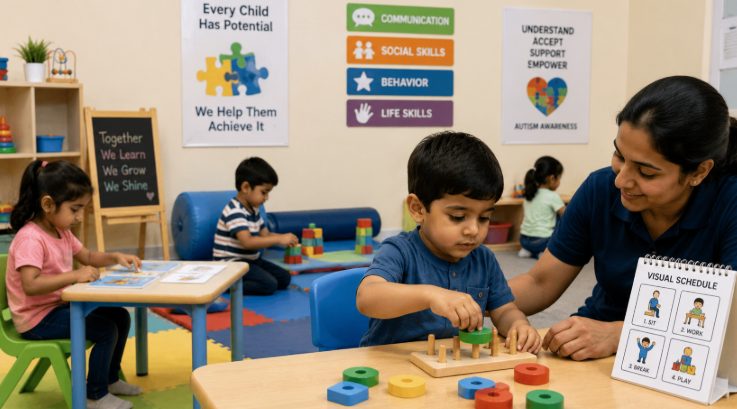
  • Visual schedules
  • Sensory breaks

Individualized Learning Support

Effective schools recognize that every child learns differently.

Look for:

  • Personalized goals
  • Differentiated instruction
  • Regular progress monitoring
  • Collaborative planning with parents

Strong Communication with Families

Successful outcomes often depend on consistent communication between educators and caregivers.

Schools should provide:

  • Regular updates
  • Parent meetings
  • Collaborative goal setting
  • Transparent support plans

The Role of Therapies Within School Settings

Modern autism education increasingly integrates therapeutic support into daily learning.

Speech and Language Therapy

Helps children improve:

  • Communication skills
  • Social interaction
  • Language comprehension
  • Functional communication

Occupational Therapy

Supports:

  • Fine motor skills
  • Sensory processing
  • Self-care abilities
  • Classroom participation

Behavioral Support

Evidence-based approaches can help children:

  • Develop self-regulation skills
  • Improve focus
  • Navigate social situations
  • Build independence

Schools that collaborate closely with therapists often provide more comprehensive support.

Supporting Social Development in School

Academic success is only one aspect of education.

School environments play a critical role in helping autistic children develop:

  • Friendships
  • Emotional regulation
  • Teamwork
  • Problem-solving abilities
  • Self-advocacy skills

Inclusive activities, peer mentoring programs, and structured social opportunities can foster meaningful connections and reduce feelings of isolation.

Technology and Autism Education in 2026

Educational technology continues to transform learning experiences for autistic students.

Popular innovations include:

  • AI-powered learning platforms
  • Visual communication tools
  • Augmentative and Alternative Communication (AAC) devices
  • Interactive learning apps
  • Virtual reality social skills training
  • Personalized adaptive learning systems

These tools help educators tailor instruction and provide greater accessibility.

Questions Parents Should Ask Before Choosing a School

Before making a decision, consider asking:

  1. What autism-specific training do teachers receive?
  2. How are Individualized Education Plans implemented?
  3. What support services are available?
  4. How does the school handle sensory needs?
  5. What is the teacher-to-student ratio?
  6. How are behavioral challenges addressed?
  7. How does the school promote inclusion and social development?
  8. What communication systems are used with parents?

The answers can provide valuable insights into whether the school is equipped to support your child effectively.

Frequently Asked Questions

Can autistic children attend regular schools?

Yes. Many autistic children successfully attend mainstream schools with appropriate accommodations, support services, and individualized learning plans.

Are special schools better for autistic children?

Not necessarily. The best option depends on the child’s unique strengths, challenges, and support requirements.

What should I look for in an autism-friendly school?

Look for trained staff, individualized support, sensory accommodations, therapy integration, and strong parent-school communication.

Can autistic children succeed academically?

Absolutely. With the right support and educational environment, autistic children can excel academically and develop valuable life skills.

Final Thoughts

Choosing a school for an autistic child is not about finding the “perfect” school—it’s about finding the right fit for your child’s individual needs, strengths, and goals.

Whether your child thrives in an inclusive classroom, a specialized educational setting, or a hybrid learning environment, the most important factor is access to understanding, support, and opportunities for growth.

At Early Autism Ventures, we believe that every autistic child deserves an educational journey that celebrates their uniqueness and unlocks their full potential. With informed decisions, collaborative support, and the right learning environment, children on the autism spectrum can build the confidence, skills, and independence needed to succeed in school and beyond.

child development centre in whitefield autism children

Child Development Center Whitefield: Comprehensive Autism Therapy & Child Development Services

By | Blog | No Comments

Looking for a Child Development Center in Whitefield?

Every child grows and develops at their own pace. However, some children may require additional support to develop communication, social, behavioral, academic, and daily living skills. If you are searching for a trusted Child Development Center in Whitefield, finding a multidisciplinary center that provides evidence-based therapies can make a significant difference in your child’s developmental journey.

At Early Autism Ventures, we offer comprehensive child development and autism intervention services designed to help children achieve their fullest potential. Our team of experienced therapists, educators, and developmental specialists provide individualized programs that focus on improving communication, behavior, learning, independence, and social interaction.

Whether your child has been diagnosed with Autism Spectrum Disorder (ASD), developmental delay, speech delay, ADHD, learning difficulties, or sensory processing challenges, our center provides the support needed to foster meaningful progress.

What Is a Child Development Center?

A Child Development Center is a specialized facility that provides assessment, intervention, therapy, and educational support for children experiencing developmental challenges.

These centers help children develop essential skills across various developmental domains, including:

  • Communication and language development
  • Social interaction
  • Behavioral regulation
  • Sensory processing
  • Motor skills
  • Academic readiness
  • Cognitive development
  • Daily living skills

A quality child development center uses a multidisciplinary approach involving therapists, special educators, psychologists, and developmental specialists working together to create individualized treatment plans.

Why Parents in Whitefield Choose Early Intervention

autism child development centre whitefield

Research consistently shows that early intervention significantly improves developmental outcomes for children with autism and developmental delays.

Children who receive therapy during their early years often demonstrate improvements in:

  • Language development
  • Social communication
  • Learning ability
  • Emotional regulation
  • Independence
  • School readiness
  • Adaptive functioning

The earlier intervention begins, the greater the opportunity for the child’s brain to develop critical learning pathways.

Early Autism Ventures: Trusted Child Development Center in Whitefield

Early Autism Ventures

We believe every child deserves the opportunity to thrive.

Our child-centered approach combines scientifically proven therapies with compassionate care to create meaningful developmental progress.

We offer:

  • ABA Therapy
  • Occupational Therapy
  • Speech Therapy
  • Shadow Teacher Support
  • Remedial Classes
  • Parent Training Programs
  • School Readiness Programs
  • Social Skills Development

Our individualized programs are designed specifically for each child’s unique strengths, challenges, and developmental goals.

ABA Therapy in Whitefield

child development whitefield

What Is ABA Therapy?

Applied Behavior Analysis (ABA Therapy) is one of the most researched and evidence-based interventions for children with Autism Spectrum Disorder.

ABA focuses on understanding behavior and teaching new skills through structured, positive reinforcement strategies.

Benefits of ABA Therapy

ABA Therapy can help children:

  • Improve communication skills
  • Develop social interaction abilities
  • Reduce challenging behaviors
  • Build attention and focus
  • Learn self-help skills
  • Improve classroom participation
  • Increase independence

At Early Autism Ventures, our certified ABA therapists create customized intervention plans tailored to each child’s developmental needs.

Who Can Benefit from ABA Therapy?

ABA Therapy is beneficial for children with:

  • Autism Spectrum Disorder
  • Developmental delays
  • Behavioral challenges
  • Social communication difficulties
  • Learning challenges

Occupational Therapy in Whitefield

Why Occupational Therapy Is Important

Occupational Therapy helps children develop the skills needed for everyday activities and independence.

Many children with autism experience challenges related to sensory processing, motor coordination, attention, and daily living skills.

Occupational Therapy Can Help With:

  • Fine motor skills
  • Handwriting
  • Sensory integration
  • Attention and concentration
  • Self-care skills
  • Feeding challenges
  • Balance and coordination
  • School participation

Our occupational therapists conduct detailed assessments to identify each child’s sensory and motor needs and create targeted intervention plans.

Speech Therapy in Whitefield

Supporting Communication Development

Communication is a fundamental life skill.

Children with autism and developmental delays may experience challenges in:

  • Expressive language
  • Receptive language
  • Speech clarity
  • Social communication
  • Conversation skills
  • Non-verbal communication

Our speech-language pathologists use evidence-based strategies to help children develop effective communication skills.

Speech Therapy Goals Include:

  • Improving vocabulary
  • Building sentence structure
  • Enhancing understanding
  • Developing conversational skills
  • Improving articulation
  • Encouraging social communication

Effective communication can significantly improve a child’s confidence, relationships, and quality of life.

Shadow Teachers for Children with Autism

Shadow Teachers

What Does a Shadow Teacher Do?

A Shadow Teacher provides one-on-one support to a child within a school environment.

The goal is to help the child successfully participate in classroom activities while promoting independence.

Benefits of Shadow Teacher Support

Shadow teachers assist with:

  • Classroom engagement
  • Behavioral support
  • Social interaction
  • Following instructions
  • Academic participation
  • Transition management
  • Emotional regulation

At Early Autism Ventures, our trained shadow teachers collaborate with parents, teachers, and therapists to create consistency between school and therapy goals.

Remedial Classes for Children with Autism

Academic Support That Makes a Difference

Many children with autism and learning differences require specialized academic instruction.

Our remedial education programs focus on helping children overcome learning challenges while building confidence and academic competence.

Areas Covered in Remedial Classes

  • Reading skills
  • Writing skills
  • Mathematics
  • Comprehension
  • Attention and focus
  • Executive functioning
  • Learning strategies

Our special educators adapt teaching methods to suit each child’s learning style and developmental level.

Signs Your Child May Benefit from Developmental Support

Parents should consider consulting a child development specialist if they notice:

  • Delayed speech or language development
  • Limited eye contact
  • Difficulty interacting with peers
  • Repetitive behaviors
  • Sensory sensitivities
  • Difficulty following instructions
  • Delayed milestones
  • Learning difficulties
  • Behavioral challenges
  • Difficulty adapting to routines

Early assessment and intervention can significantly improve outcomes.

Frequently Asked Questions

Which is the best Child Development Center in Whitefield?

The best child development center offers multidisciplinary services including ABA Therapy, Speech Therapy, Occupational Therapy, Shadow Teacher support, and Remedial Education under one roof. Early Autism Ventures provides comprehensive, evidence-based intervention programs tailored to each child’s needs.

What therapies are available for autism in Whitefield?

Children with autism may benefit from:

  • ABA Therapy
  • Occupational Therapy
  • Speech Therapy
  • Special Education
  • Shadow Teacher Support
  • Social Skills Training
  • Parent Training Programs

At what age should autism therapy begin?

Early intervention is recommended as soon as developmental concerns are identified. Research shows that therapy initiated during the preschool years often produces better outcomes.

How often should a child attend therapy?

The frequency depends on the child’s developmental profile, goals, and assessment results. Individualized therapy plans are created after a comprehensive evaluation.

Why Families Trust Early Autism Ventures

Parents choose Early Autism Ventures because of our:

  • Individualized intervention plans
  • Experienced multidisciplinary team
  • Evidence-based therapies
  • Family-centered approach
  • Progress monitoring systems
  • Child-friendly environment
  • School collaboration support

We focus on meaningful outcomes that help children develop skills for everyday life, school success, and long-term independence.

Begin Your Child’s Development Journey Today

If you are searching for a reliable Child Development Center in Whitefield, Early Autism Ventures is here to support your child every step of the way.

Our comprehensive services include:

✓ ABA Therapy in Whitefield
✓ Occupational Therapy in Whitefield
✓ Speech Therapy in Whitefield
✓ Shadow Teacher Services
✓ Remedial Classes for Children with Autism
✓ Early Intervention Programs
✓ Autism Assessment Support
✓ Parent Guidance and Training

Every child has unique strengths and limitless potential. With the right support, guidance, and intervention, children can build the skills they need to thrive at home, in school, and in life.

Contact Early Autism Ventures today to learn more about our personalized child development and autism therapy programs in Whitefield.