Before techniques, before targets, before flashcards, there is relationship. And relationship is where communication begins.
Think about the last time you really opened up to someone. Chances are, it wasn’t in a formal setting with a clipboard and a timer. It was with someone you trusted. Someone who listened. Someone who made you feel safe enough to find your words.
Now imagine being a child who already struggles to communicate, and being asked to do so in a room with a stranger, under pressure, with a goal sheet on the wall.
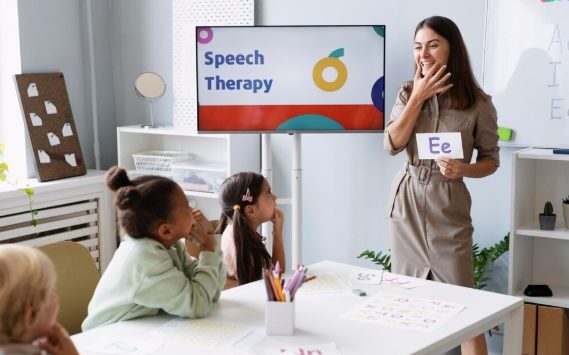
This is exactly why the most effective speech therapy for children doesn’t start with drills. It starts with connection.
The relationship between a child and their Speech-Language Pathologist (SLP) isn’t a nice-to-have. It is, quite literally, the medium through which all communication growth happens. And for children with autism, language delays, or sensory motor speech difficulties, that connection is not just helpful, it is the therapy.
Let’s talk about why.
Communication Is Relationship, Right From the Start
Long before a child speaks their first word, they are communicating. A newborn makes eye contact. A baby reaches toward a parent’s face. A toddler points at a dog and looks back to share the excitement.
These are called joint attention skills, and they are the bedrock of all language development.
Research also found that joint attention, the ability to share focus on an object or event with another person, is one of the strongest early predictors of language outcomes in children with autism. Children who develop stronger joint attention skills develop stronger language.
Full stop.
This means that speech therapy for autism isn’t just about teaching words. It’s about building the social-communicative foundation that makes words meaningful. And that foundation is built through interaction, warm, responsive, attuned interaction between a child and the people around them.
Schedule Your Free Consultation with Early Autism Ventures Today.
What “Connection” Actually Means in a Therapy Room
Connection in pediatric speech therapy isn’t about being friendly (though that helps). It’s a clinical approach, intentional, evidence-based, and deeply effective.
It looks like:
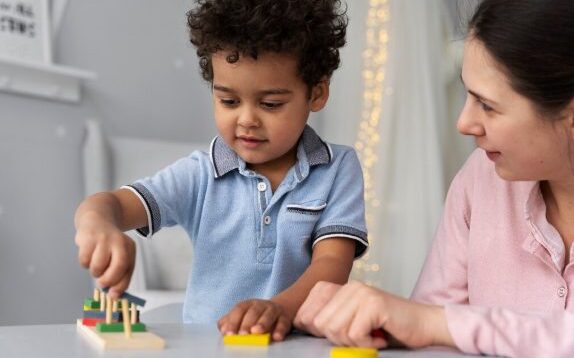
- Following the child’s lead, letting the child’s interests, pace, and energy guide the session rather than imposing a rigid agenda
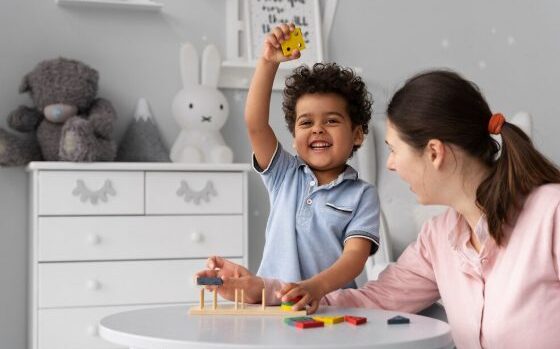
- Responsive interaction, responding immediately and warmly to any communicative attempt, however small, a look, a reach, a sound
- Serve and return, the back-and-forth exchanges that neuroscientists at Harvard’s Center on the Developing Child describe as the single most important driver of early brain development
- Reducing pressure, creating an environment where communication feels safe, not evaluated
- Natural reinforcement, using the interaction itself as the reward, rather than external praise alone
When a child feels genuinely seen and responded to, their nervous system relaxes. And a relaxed nervous system is infinitely more capable of learning new communication skills than a stressed one.
The Neuroscience Behind It: Why Safety Encourages Speech
Here’s something that sounds simple but is profoundly important: the brain cannot learn well when it feels threatened.
Dr. Stephen Porges’ Polyvagal Theory, now widely applied in speech-language therapy, explains that the social engagement system (the part of the nervous system responsible for facial expression, vocal prosody, and listening) only activates when a child feels safe. When a child is anxious, overwhelmed, or dysregulated, that system shuts down.
This is why a child who says words at home goes silent in a therapy room. It’s not defiance. It’s neurology.
Skilled speech-language pathologists understand this. They spend the first weeks, sometimes months, of therapy not targeting speech at all, but building the felt sense of safety that allows speech to emerge. They modulate their voice, slow their pace, follow the child’s gaze, reduce demands, and create an environment the child’s nervous system reads as safe.
This is not wasted time. This is therapy.
Interaction-Based Approaches: What the Research Supports
Several well-researched, interaction-based approaches in speech and language therapy place relationship and social engagement at their core.
Here’s a look at the most impactful:
Floortime / DIR (Developmental, Individual Difference, Relationship-Based Model)
Developed by Dr. Stanley Greenspan, Floortime meets children at their current developmental level and builds upward through play-based, child-led interaction. Rather than targeting isolated skills, Floortime strengthens the entire arc of social-emotional and communicative development. A study found significant improvements in communication and social functioning in children with autism who received DIR/Floortime intervention.
SCERTS Model

PRT: Pivotal Response Treatment
Pivotal Response Treatment (PRT) is a naturalistic ABA-based intervention that uses the child’s motivation and natural interactions to drive communication gains. By targeting “pivotal” areas, motivation, responsivity to multiple cues, and self-management, PRT produces broad improvements in language and social communication. Plus, it has also been demonstrated that PRT produced faster language gains than more structured, drill-based approaches.
“It Takes Two to Talk” and “More Than Words”
“It Takes Two to Talk” teaches parents to follow their child’s lead, interpret early communicative signals, and create natural opportunities for interaction. Studies show that children whose parents implement Hanen strategies make significantly greater speech therapy progress than those receiving clinic-only intervention.
The common thread through all of these? Interaction is the intervention.
Schedule Your Free Consultation with Early Autism Ventures Today.
The Parents’ Role: You Are Your Child’s First Speech Therapist
This deserves its own section, because it is that important.
Your child does not spend most of their waking hours in a therapy room. They spend them with you. And the quality of communication interaction in your everyday relationship with your child is one of the most powerful drivers of their language development.
This doesn’t mean you need to turn every moment into a therapy session. (Please don’t. For everyone’s sake.)
But it does mean that the small, everyday moments, bath time, mealtimes, the car journey to school, are rich opportunities for the kind of warm, responsive interaction that builds communication.
Research from ASHA (American Speech-Language-Hearing Association) consistently shows that parent-implemented communication strategies, guided by an SLP, produce outcomes that are at least as strong as, and sometimes stronger than, therapist-only intervention.
At the heart of this is one simple principle: respond to every communicative attempt. A look. A gesture. A sound. A point. When you respond, warmly, immediately, and consistently, you teach your child that communication works. And that lesson is the foundation of everything else.
Connection and Interaction for Non-Speaking Children
For children who are non-speaking or minimally verbal, the role of connection and interaction becomes even more critical and more nuanced.
Non-speaking children communicate. They always do. Through eye gaze, body language, facial expression, vocalisation, reaching, and behaviour. The job of a skilled speech-language pathologist is first to see and respond to those communications, validating the child as a communicator before a single word or device is introduced.
Augmentative and Alternative Communication (AAC), whether a speech-generating device, a PECS system, or a communication app, is most effective when it is introduced within a warm, interactive relationship. Research also confirms that AAC outcomes are significantly better when communication partners are responsive, consistent, and emotionally attuned.
Giving a child an AAC device without building the relational context around it is a bit like handing someone a phone but never answering when they call. The device is the tool. The relationship is the reason to use it.
Interaction in Group vs. Individual Speech Therapy
One question parents often ask is whether individual speech therapy or group speech therapy is more effective. The answer, as with most things in child development, is: it depends.
Individual speech therapy allows the SLP to focus entirely on one child’s goals, build a deep one-to-one relationship, and target specific speech and language delays with precision.
Group speech therapy offers something individual sessions cannot: peer interaction. For children working on pragmatic language skills, social communication, and conversation skills, group settings provide authentic, naturalistic communication opportunities that can’t be replicated with an adult alone.
Many children benefit most from both, and the best speech therapy programs integrate individual skill-building with supported social interaction as the child is ready.
Red Flags That Your Child May Need Support With Social Communication
Social communication difficulties can be subtle, especially in children who have strong vocabularies. Watch for:
- Difficulty initiating or maintaining a conversation
- Talking at people rather than with them
- Struggling to take conversational turns
- Missing nonverbal cues, facial expressions, tone of voice, and body language
- Difficulty understanding jokes, sarcasm, or implied meaning
- Preferring parallel play to interactive play beyond typical ages
- Becoming dysregulated in socially demanding situations
- Limited spontaneous communication, speaks only when prompted
These are hallmarks of pragmatic language disorder and social communication disorder, both well within the scope of speech-language therapy, and both highly responsive to interaction-based intervention.
How Early Autism Ventures Puts Connection at the Centre of Speech Therapy
At Early Autism Ventures (EAV), we believe in something deeply simple: children learn to communicate through communication. Not around it, not despite it, through it.
Our Speech-Language Pathologists are trained not just in the techniques of speech therapy, but in the art of connection. They know how to read a child’s cues. They know when to push gently and when to follow. They know that a child who feels safe is a child who is ready to learn.
Here’s what that looks like in practice at EAV:
- Comprehensive speech-language assessments that evaluate not just speech targets but social communication, joint attention, emotional regulation, and interaction quality
- Individualized therapy plans drawing on the most evidence-based interaction approaches, Floortime, SCERTS, PRT, and AAC
- Free parent training sessions where we coach families in the exact responsive interaction strategies that will accelerate their child’s progress at home, because you are the most important communication partner your child has
- Structured observations at every level, parents observe sessions firsthand, supervisors observe therapists to ensure clinical excellence, and our team continuously observes each child to keep goals relevant and responsive
- Collaborative work with our ABA therapy team, our BCBAs use positive reinforcement and naturalistic teaching strategies that reinforce the same communication goals our SLPs are targeting, creating consistency across every hour of your child’s day
We don’t just teach children to speak. We teach them that communication is worth it, that the people around them will listen, respond, and delight in what they have to say.
That belief changes children. We’ve watched it happen, again and again.
The Most Important Thing You Can Do Today
Connection is not a therapy technique. It’s a fundamental human need, and for children who struggle to communicate, it is also the most powerful therapeutic force available.
If your child is struggling with speech, language, or social communication, the single most important thing you can do is find a team that understands this. A team that will meet your child where they are, build a relationship before building targets, and treat your family as true partners in the process. That’s exactly what Early Autism Ventures is here to be.
Your child is already communicating. Let’s help the world hear them.
Schedule Your Free Consultation with Early Autism Ventures Today.
Because every child deserves to be heard, and every family deserves a team that listens.


Recent Comments