Parents usually ask this question the moment autism enters the conversation. The honest answer is simple. Start as early as possible. Research points to age two as an ideal window. But ABA therapy can help a child at any age, from eighteen months to adolescence and beyond.
This article breaks down what the research says, why early intervention matters so much, and what to do if your child is past the “ideal” window.
The Short Answer: Earlier Is Better, But It’s Never Too Late
Most developmental pediatricians and behavior analysts recommend starting ABA therapy between two and six years of age. This is when the brain shows the highest degree of neuroplasticity. Skills learned during this window tend to generalize faster and stick longer.
That said, ABA therapy is not a closed door after age six. Children, teenagers, and even adults benefit from ABA-based interventions. The goals shift with age, but the underlying science of behavior change stays useful across the lifespan.
Why Age Two to Six Matters So Much
A child’s brain forms new neural connections at a faster rate in the first six years of life than at any other stage. This is why early intervention programs across Bangalore, Hyderabad, and the rest of India focus heavily on toddlers and preschoolers.
During this window, ABA therapy typically targets:
Joint attention and eye contact
Functional communication, including first words and requesting skills
Imitation and play skills
Reducing behaviors that interfere with learning, such as tantrums or self-stimulatory behavior
Early social skills like turn-taking and responding to name
Children who start ABA therapy early often need fewer intervention hours later in life. Some go on to attend mainstream schools with little to no additional support. This is not a guarantee for every child, but it is a well-documented pattern across decades of autism research.
Signs a Toddler Might Benefit From an Evaluation
Parents don’t need a diagnosis in hand before booking an evaluation. If you notice any of the following by 18 months, it is worth a conversation with a developmental pediatrician or a board certified behavior analyst:
Limited or no eye contact
No response to their name being called
Delayed babbling or first words
Little interest in other children or shared play
Repetitive movements like hand flapping or lining up toys
Loss of previously acquired words or skills
Waiting for a formal autism diagnosis before seeking help costs valuable time. Many ABA providers, including Early Autism Ventures, offer early intervention support alongside the diagnostic process.
What If My Child Is Already Past Age Six?
Plenty of children start ABA therapy at seven, ten, or even fifteen and make meaningful progress. The therapy simply adjusts its targets. Instead of foundational communication and play skills, older children often work on:
Conversational and social skills
Emotional regulation
Academic and classroom readiness
Daily living and self-care independence
Reducing behaviors that affect school or family life
Age should never be a reason to avoid starting therapy. The right question is not “did we miss the window” but “what does my child need right now.”
How Early Autism Ventures Approaches Age-Specific Therapy
Every child’s ABA program at Early Autism Ventures starts with an individual assessment, regardless of age. Therapists build a plan around the child’s current skills, family goals, and daily routines rather than a fixed template. This applies across our centers in Bangalore (Sahakar Nagar, Whitefield, Kalyan Nagar) and Hyderabad.
Programs are adjusted every few months based on progress data, so a toddler’s plan looks nothing like a ten-year-old’s plan even though both fall under the same therapy approach.
Key Takeaway
If your child is under six, don’t wait for a formal diagnosis to start exploring ABA therapy. If your child is older, don’t assume the window has closed. ABA therapy meets children where they are, at whatever age that happens to be.
Consider this: your child has a hundred things to say, a world full of thoughts, emotions, and ideas. But the words just won’t come out.
Frustrating? Absolutely. For parents of children with autism, this scenario is all too real.
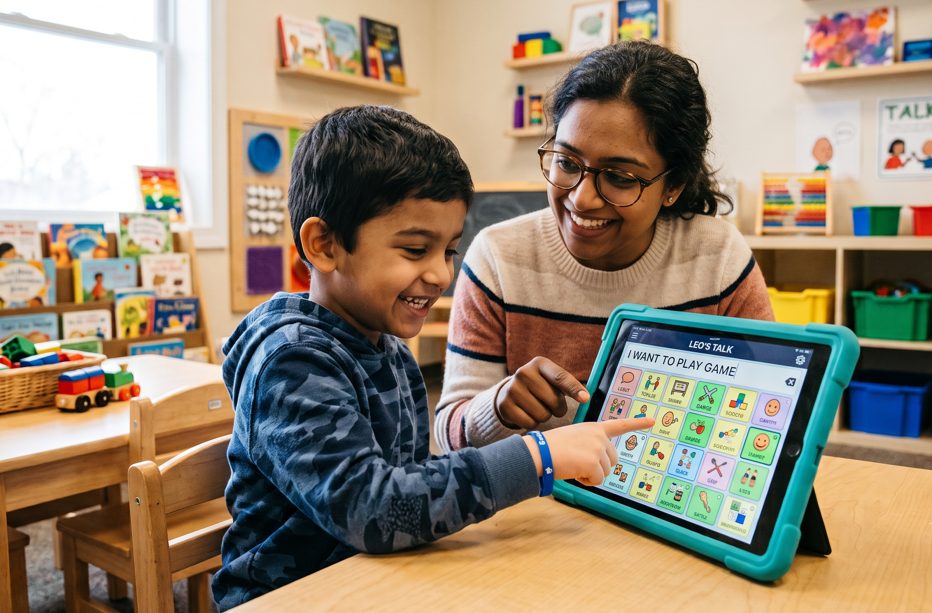
But here’s the good news: Augmentative and Alternative Communication (AAC) technology is rewriting that story, one tap, swipe, and symbol at a time.
AAC has come a long way from clunky laminated picture boards and binders thick enough to double as doorstops. Today, it’s sleek apps, intelligent devices, and science-backed strategies that help children communicate, connect, and thrive. And when you pair AAC with qualityspeech therapy for children with autism, the results can be genuinely life-changing.
In this blog, we explore the latest and greatest in AAC advancements, why they matter, and how the right therapeutic support, includingABA therapy andspeech therapy, can boost your child’s communication potential.
Did You Know?
Around 25–30% of children with autism are minimally verbal or non-speaking, meaning they produce fewer than 20 functional words. Plus,research shows that AAC use does not hinder speech development, but actually supports it.
What Is AAC and Why Does It Matter?
AAC stands for Augmentative and Alternative Communication, an umbrella term for tools and strategies that support communication beyond spoken words. It includes everything from simple picture exchange systems to high-tech speech-generating devices (SGDs) powered by artificial intelligence.
For children with autism, AAC is not a last resort. It’s often a first resort, a bridge to self-expression, while speech therapy for kids with autism works alongside it to build verbal and nonverbal communication skills together.
The Latest AAC Advancements You Need to Know About
AI-Powered Communication Apps
Apps like Proloquo2Go, Snap Core First, and TouchChat have evolved dramatically. These platforms now use predictive text, personalised vocabulary, and natural language processing to make communication faster and more intuitive. Think of it like autocorrect, but for your child’s entire voice.
In fact, a study in theJournal of Autism and Developmental Disorders found that children who used dynamic display AAC apps showed significant improvements in both receptive and expressive language skills.
Eye-Gaze Technology
For children with limited motor control, eye-gaze devices track eye movements to select words and phrases on screen. Brands likeTobii Dynavox have made this technology more accessible and affordable. Eye-gaze AAC allows even children with complex physical and communication needs to express themselves independently, and that independence is, honestly, everything.
Robust Vocabulary Systems
Gone are the days of AAC systems built around basic needs like “eat” and “toilet.” Modern AAC systems now use robust vocabulary frameworks that give children access to a full language system, verbs, questions, connectives, emotions, and humour. (Yes, your child can finally tell you their jokes. Brace yourself.)
A robust AAC system, when modelled consistently during speech therapy for children with autism, helps children develop grammar, narrative, and conversational skills, not just single-word requests.
Wearable AAC and Smart Devices
Smartwatches and wearable devices are now being adapted for AAC use, allowing children to communicate on the go, no tablet required. Companies are also integrating AAC into smart home systems, so children can control their environments and communicate preferences throughout the day.
Partner-Assisted Scanning and Switch Access
For children who need support beyond touchscreens, partner-assisted scanning and switch access devices offer alternative ways to navigate AAC systems. SLPs (Speech-Language Pathologists) typically lead the assessment of a child’s motor, visual, and cognitive access needs to determine the most appropriate method, whether that’s eye gaze, switch scanning, or partner-assisted scanning.
A BCBA can then work alongside the speech therapy team to build these access strategies into the child’s daily routines and reinforcement plan, ensuring consistent practice across therapy sessions and at home. This collaborative approach, SLP-led assessment paired with BCBA-supported implementation, forms the backbone of a truly comprehensive, individualised communication plan.
So how does speech therapy work in the context of AAC? It’s not just about handing a child a device and hoping for the best (we wish it were that simple). Speech therapy for kids with autism involves a highly structured, individualised approach:
A certified Speech-Language Pathologist (SLP) assesses the child’s current communication profile.
Together with a BCBA (Board Certified Behavior Analyst), they identify the best AAC system and access method.
The SLP models AAC use throughout every session, known as Aided Language Input or Aided Language Stimulation.
Goals are embedded in play, daily routines, and structured activities to maximise carryover.
Speech therapy progress is tracked regularly, with data collected on communication rates, vocabulary use, and spontaneous language.
At Early Autism Ventures (EAV), our speech therapists don’t work in silos. They collaborate directly with BCBAs, QBAs, and occupational therapists to build a communication ecosystem around your child. For children who need support beyond touchscreens, our SLPs assess motor, visual, and cognitive access needs to determine the right AAC pathway, whether that’s eye gaze, switch access, or partner-assisted scanning, and our BCBAs then help weave these strategies into daily routines so they actually stick. Because language doesn’t just happen in a therapy room, it happens at breakfast, bedtime, and everywhere in between.
The Role of ABA Therapy in Communication Development
You can’t talk about AAC without talking about ABA therapy. Applied Behaviour Analysis provides the motivational and behavioural scaffolding that helps children learn to use communication tools consistently and meaningfully.
The ABA therapy benefits in the context of communication are well-documented:
Positive reinforcement, or rewarding communication attempts, increases the frequency and variety of communication behaviours.
Structured teaching formats like DTT (Discrete Trial Training) help children learn to associate AAC symbols with meanings systematically.
Natural Environment Teaching (NET) ensures skills generalise to real-world settings.
Behaviour momentum strategies help hesitant communicators take the leap.
The interplay of positive and negative reinforcement ABA therapy techniques makes autism ABA therapy particularly effective for building communication. Positive reinforcement rewards desired communication, while negative reinforcement can be used to remove an aversive (like an unpreferred activity) when a child successfully communicates a request, making communication genuinely functional and rewarding from the child’s perspective.
Why Speech Therapy Progress Monitoring Is Non-Negotiable
One of the most underrated parts of effective speech therapy for children with autism is speech therapy progress monitoring. Without tracking data, you’re essentially navigating without a map, which, let’s be honest, no parent wants to do.
Effective speech progress monitoring includes:
Baseline assessments of communication skills at the start of the intervention
Weekly or bi-weekly data collection on target goals (e.g., number of spontaneous AAC utterances, response accuracy)
Regular parent-facing progress reports so families know exactly what’s happening, no guesswork required
Quarterly goal reviews, with adjustments made by both the SLP and the BCBA based on data trends
At EAV, all speech therapy progress is monitored by SLP-, QQBA- and BCBA-supervised teams, ensuring clinical rigour in every step. Our parents receive regular updates and are trained to support AAC use at home, because a communication strategy that only works in a therapy room isn’t really working at all.
Tips for Parents: Supporting AAC at Home
You don’t need a degree in speech therapy to support your child’s AAC use at home. Here are some evidence-based, parent-friendly strategies:
Model, model, model. Use the AAC device yourself throughout the day. Narrate your actions, feelings, and requests. Children learn by watching.
Follow the child’s lead. Comment on what they’re interested in using their device for. Don’t always make it about requests.
Accept all communication attempts. Whether it’s a tap, a point, a vocalisation, or a look, honour it. Respond as if it were a full sentence.
Don’t ask too many questions. Comments and observations invite more language than interrogation. “You love that truck!” beats “What is that?” every time.
Bring the device everywhere. The park, the supermarket, family dinners, AAC goes where your child goes.
If you’re unsure how to implement any of this, EAV offers training sessions where our therapists help you build AAC into your family’s daily life. No awkward classroom settings. Just real support.
Choosing the Right AAC System for Your Child
Not all AAC systems are created equal, and the right choice depends entirely on your child’s individual profile. Key factors include:
Motor and cognitive abilities
Language level (pre-symbolic, emerging, or language user)
Visual processing strengths
Family lifestyle and daily routines
Child’s interests and motivators
An experienced SLP will carry out a comprehensive feature-matching assessment before recommending any system. At EAV, this assessment happens in the context of a full developmental profile, including sensory, motor, and behavioural considerations. Because the best AAC system is the one your child will actually use.
How Early Autism Ventures (EAV) Can Help Your Child
At Early Autism Ventures (EAV), we believe every child deserves a voice, and we’re here to help find it.
Here’s what sets EAV apart:
Integrated therapy model: Our speech therapists, BCBAs, and occupational therapists work as a unified team, not in separate silos. Your child gets a truly holistic communication plan.
SLP-led monitoring: Every plan is monitored by a qualified SLP to ensure clinical standards and measurable outcomes.
Free parent training: We don’t just work with your child. We work with you. Our therapists train parents in AAC modelling, positive reinforcement strategies, and communication facilitation at home.
Home visit programme: Our therapists can visit your home to observe your child’s natural communication environment and provide context-specific guidance.
Evidence-based practice: We use only scientifically validated approaches, from autism ABA therapy to the latest AAC technologies.
Transparent progress monitoring: You’ll always know how your child is progressing. Our speech therapy progress reports are clear, regular, and parent-friendly.
We’re not here to dazzle you with jargon. We’re here because we genuinely love what we do, and we genuinely care about your child. Every session at EAV starts with curiosity and ends with data, because we know that’s what truly moves the needle.
Ready to Give Your Child a Voice? Let’s Talk.
Your child has so much to say. The world is ready to hear them. And EAV is ready to help them say it.
We’re offering a FREE initial consultation to families who want to explore AAC options, speech therapy for kids with autism, or integrated autism ABA therapy programmes. Our SLP-led team will sit down with you, understand your child’s unique needs, and map out a clear, achievable plan together.
Yes. Many children with autism can and do attend regular school. Whether mainstream school is the right setting for a specific child depends on the severity of their autism, their communication skills, sensory needs, and the level of support the school and family can put in place. There is no single answer that fits every child on the spectrum, but with early intervention, the right accommodations, and a collaborative plan between parents, therapists, and teachers, regular school is a realistic and often beneficial option for a large number of autistic children.
This guide breaks down what the research says, what the law in India requires, how to know if your child is ready, and how therapies like ABA (Applied Behavior Analysis) help bridge the gap between diagnosis and the classroom.
Quick Answer
Children with autism can attend regular school when they have functional communication skills, can manage transitions and sensory input with support, and have access to accommodations such as an Individualized Education Plan (IEP), a shadow teacher or special educator, and teachers trained in autism-friendly practices. Children with more significant support needs may benefit from a blended approach: part-time mainstream inclusion alongside specialized therapy, or a special school environment until foundational skills are in place. The decision is never permanent. Many children move between special education settings and mainstream classrooms as their skills develop.
Understanding the Different Schooling Options
Before deciding on regular school, it helps to understand the full range of options available to families of autistic children.
Mainstream or regular school (full inclusion). The child attends general education classes alongside typically developing peers for the entire school day, sometimes with additional support like a shadow teacher or resource room access.
Partial inclusion. The child spends part of the day in a general classroom and part of the day in a resource room or with a special educator for subjects or skills that need more individualized attention.
Special school. A school designed specifically for children with developmental disabilities, offering a curriculum, pace, and sensory environment tailored to their needs.
Home-based or center-based education. Used for children with more significant support needs, often combined with ABA therapy, speech therapy, and occupational therapy before a transition to a school setting is attempted.
None of these options are mutually exclusive. A child’s placement can and often does change over time based on progress.
What Does the Research Actually Say?
Global research on autism and inclusive education presents a nuanced picture, not a simple yes or no.
A 2025 cross-sectional study of 860 children with autism in China found that 36.2% of children on the autism spectrum attended mainstream school, and the study specifically examined whether mainstream placement improved social inclusion outcomes for children and their parents.
A 10-year follow-up cohort study from France (the EpiTED study) found that inclusion of children with autism in mainstream schools had a positive impact on their social and daily living behaviors, while also identifying that greater autonomy and lower symptom severity were linked to a higher likelihood of successful mainstream inclusion over time.
Parent perspective research out of Australia found that regular mainstream classrooms were the preferred option for roughly half of parents of autistic students, largely because they wanted their child to learn to function in a real-world setting and build relationships with mainstream peers. At the same time, the same study found that a majority of parents raised concerns about how well regular classrooms could accommodate their child’s learning, emotional, or sensory needs, even when they supported inclusion in principle.
Research on teachers consistently points to one deciding factor above all others: preparation. Studies on inclusive education repeatedly find that a teacher’s knowledge of autism and their attitude toward inclusion are strong predictors of whether inclusion actually succeeds in the classroom.
The takeaway for parents: mainstream schooling is not automatically right or automatically wrong. Outcomes depend heavily on the child’s individual profile and on how well-prepared the school and support team are.
What the Law Says About Autism and Regular School in India
Parents in India do not need to rely on a school’s goodwill alone. The law is on your side.
The Rights of Persons with Disabilities (RPWD) Act, 2016 legally recognizes autism spectrum disorder as a disability and gives children with autism the right to study in mainstream schools with reasonable accommodations under Section 17 of the Act. The Act defines inclusive education as a system where students with and without disability learn together, with teaching adapted to meet the needs of different learners, placing the responsibility on the school to adapt rather than on the child to fit in.
The Right to Education (RTE) Act, 2009 guarantees free and compulsory education for every child between the ages of six and fourteen, including children with disabilities, and mandates that private schools reserve a percentage of seats for disadvantaged and disabled children.
Courts have upheld these rights in practice. In one notable case, the Delhi High Court directed a private school to readmit a child with mild autism after the school withdrew her due to reluctance to provide a shadow teacher, reinforcing that inclusive education is not optional and failure to provide reasonable accommodation amounts to discrimination under the RPWD Act.
In short, a regular school in India cannot lawfully deny admission to a child solely because of an autism diagnosis, and is expected to provide reasonable support such as a shadow teacher, adapted assessments, or a special educator on staff. In practice, implementation varies widely between schools, which is why preparation on the family’s side matters just as much as the legal right.
Factors That Determine If Regular School Is the Right Fit
Every child’s profile is different. These are the areas therapists and educators typically assess before recommending mainstream school:
Communication ability. Can the child express basic needs, follow simple instructions, and understand classroom language, whether verbally or through an alternative communication method?
Social engagement. Does the child show interest in peers and tolerate group activities, even if social skills are still developing?
Sensory regulation. How does the child respond to a noisy, crowded classroom, bright lights, or a full-day schedule?
Behavioral readiness. Can the child manage transitions, follow a routine, and cope with frustration without behaviors that would be disruptive or unsafe in a large classroom?
Academic foundation. Does the child have the pre-academic or academic skills needed to keep pace, with or without modified content?
Level of support available. Will the school provide a shadow teacher, resource room, or trained special educator, and is the family able to supplement with therapy outside school hours?
None of these need to be perfect. They need to be at a level where the classroom becomes a place of growth rather than constant distress for the child.
Signs a Child May Be Ready for Mainstream School
Follows two-to-three step instructions independently or with minimal prompting
Communicates basic needs and wants, verbally or through AAC (Augmentative and Alternative Communication)
Tolerates group settings for extended periods without significant distress
Shows interest in imitating or interacting with peers
Can sit, transition between activities, and follow a basic daily routine
Has a support plan in place: therapy continuing alongside school, a documented IEP, and school staff briefed on the child’s needs
If a child is not yet showing these signs, that does not mean regular school is off the table forever. It usually means more foundational work, often through ABA therapy, speech therapy, or occupational therapy, needs to happen first.
How ABA Therapy Helps Prepare Children for Regular School
ABA (Applied Behavior Analysis) therapy is one of the most well-established, evidence-based interventions for building the exact skills that mainstream classrooms require: functional communication, social engagement, following instructions, tolerating transitions, and reducing behaviors that interfere with learning.
At Early Autism Ventures, school readiness is built into the therapy plan itself, not treated as an afterthought. This typically includes:
Functional communication training so the child can request, protest, and share appropriately in a classroom setting
Social skills groups that simulate peer interaction, turn-taking, and group instruction before the child ever sets foot in a classroom
Sensory and behavior support plans that identify triggers and build coping strategies for a full school day
Pre-academic and academic skill building aligned with age-appropriate school expectations
Collaboration with schools including shadow teacher training, IEP input, and ongoing consultation with classroom teachers once the child transitions in
This bridge between therapy and classroom is often the single biggest factor in whether a mainstream placement succeeds long term.
Benefits of Inclusive Education
Real-world social exposure. Children learn to navigate friendships, group dynamics, and everyday social expectations alongside typically developing peers.
Higher expectations, more opportunity. Mainstream curricula can push a child’s academic and communication growth further than a segregated setting sometimes allows.
Benefits for all students, not just autistic children. Research on inclusive classrooms consistently finds that inclusive education benefits both children with and without disabilities by building empathy and normalizing neurodiversity from an early age.
Reduced stigma over time. Early, well-supported inclusion helps shift how classmates, teachers, and communities understand and accept autism.
Common Challenges and How to Address Them
Challenge: Lack of teacher training. Solution: Request teacher orientation sessions from your child’s therapy team before the school year starts, and share a simple one-page profile covering triggers, communication style, and effective strategies.
Challenge: Sensory overload in large classrooms. Solution: Ask the school about a quiet corner or sensory break option, noise-reducing headphones, and a predictable seating arrangement.
Challenge: Social isolation despite physical inclusion. Solution: Structured peer-buddy programs and small group activities work far better than simply placing a child in a classroom and hoping interaction happens naturally.
Challenge: Academic pace mismatch. Solution: An IEP with modified assessments or pacing, agreed upon with the school in writing, protects the child from being pushed too fast or left behind.
Challenge: Inconsistent implementation of legal rights. Solution: Parents can formally request accommodations in writing, citing the RPWD Act 2016, and escalate to the school management or education department if requests are denied.
Frequently Asked Questions
Can a school legally refuse admission to a child with autism in India? No. Under the RPWD Act, 2016, and the RTE Act, 2009, schools in India cannot deny admission to a child solely on the basis of an autism diagnosis. Schools are required to provide reasonable accommodations such as a shadow teacher or modified assessments.
What is a shadow teacher and does my child need one? A shadow teacher is a support professional who accompanies a child with autism in the classroom to help with instructions, transitions, and behavior management. Many children benefit from a shadow teacher during the initial transition to mainstream school, with support gradually reduced as independence grows.
At what age should I start preparing my child for regular school? Ideally, preparation begins as early as possible after diagnosis, often between ages two and five, through early intervention and ABA therapy. This gives the child the longest possible runway to build the communication, social, and behavioral skills mainstream school requires.
Can a child move from a special school to a regular school later? Yes. School placement is not permanent. Many children start in a special school or home-based program, build foundational skills through therapy, and transition into mainstream school once they are ready. Others move in the opposite direction if a mainstream setting is not meeting their needs.
Does every child with autism need an IEP to attend regular school? Not necessarily, but an IEP is strongly recommended for children who need academic modifications, behavior support plans, or specific accommodations. It creates a documented, agreed-upon plan between parents, therapists, and the school.
Will my child be bullied in a regular school? Bullying is a valid concern for any child with visible differences. It is best addressed proactively: peer sensitization programs, teacher awareness training, and open communication between parents and school staff significantly reduce this risk. It should not be a reason to avoid inclusion altogether, but it is a reason to choose a school that takes it seriously.
The Bottom Line
Children with autism can go to regular school, and many thrive there, but success depends on matching the right level of support to the right child at the right time. The goal is not to force every child into a mainstream classroom regardless of readiness. It is to build the skills, put the legal and practical supports in place, and make an informed decision based on the individual child rather than a blanket assumption in either direction.
If you are trying to figure out whether your child is ready for regular school, or want to build the foundational skills needed to get there, Early Autism Ventures can help design a therapy plan focused specifically on school readiness and long-term inclusion.





Recent Comments