Consider this: your child has a hundred things to say, a world full of thoughts, emotions, and ideas. But the words just won’t come out.
Frustrating? Absolutely. For parents of children with autism, this scenario is all too real.
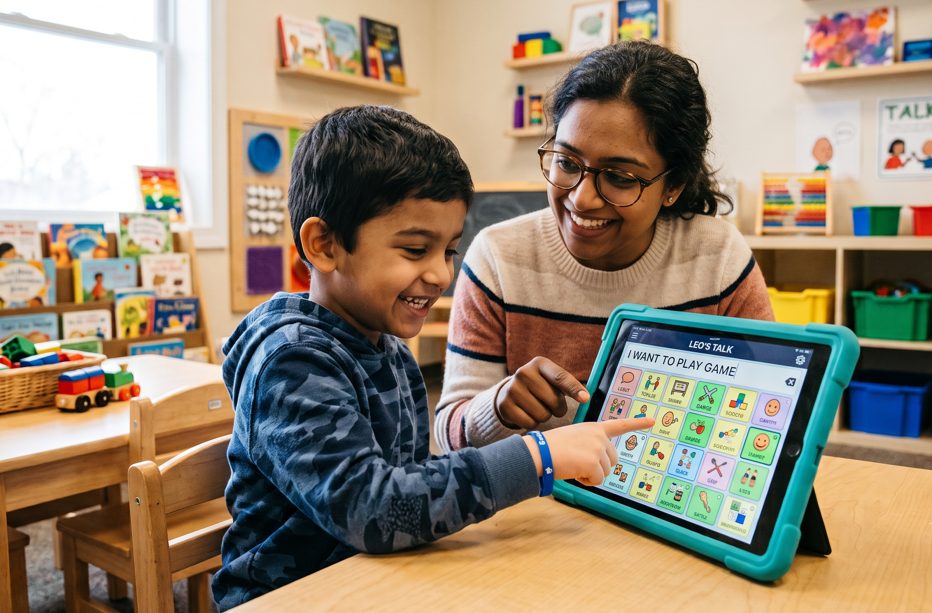
But here’s the good news: Augmentative and Alternative Communication (AAC) technology is rewriting that story, one tap, swipe, and symbol at a time.
AAC has come a long way from clunky laminated picture boards and binders thick enough to double as doorstops. Today, it’s sleek apps, intelligent devices, and science-backed strategies that help children communicate, connect, and thrive. And when you pair AAC with quality speech therapy for children with autism, the results can be genuinely life-changing.
In this blog, we explore the latest and greatest in AAC advancements, why they matter, and how the right therapeutic support, including ABA therapy and speech therapy, can boost your child’s communication potential.
Did You Know?
Around 25–30% of children with autism are minimally verbal or non-speaking, meaning they produce fewer than 20 functional words. Plus, research shows that AAC use does not hinder speech development, but actually supports it.
What Is AAC and Why Does It Matter?
AAC stands for Augmentative and Alternative Communication, an umbrella term for tools and strategies that support communication beyond spoken words. It includes everything from simple picture exchange systems to high-tech speech-generating devices (SGDs) powered by artificial intelligence.
For children with autism, AAC is not a last resort. It’s often a first resort, a bridge to self-expression, while speech therapy for kids with autism works alongside it to build verbal and nonverbal communication skills together.
When speech therapy is combined with AAC, children learn to use multiple channels of communication simultaneously, a method strongly supported by the American Speech-Language-Hearing Association (ASHA).
Wondering if AAC is right for your child? Book a FREE consultation with EAV’s speech therapy team.
The Latest AAC Advancements You Need to Know About
- AI-Powered Communication Apps
Apps like Proloquo2Go, Snap Core First, and TouchChat have evolved dramatically. These platforms now use predictive text, personalised vocabulary, and natural language processing to make communication faster and more intuitive. Think of it like autocorrect, but for your child’s entire voice.
In fact, a study in the Journal of Autism and Developmental Disorders found that children who used dynamic display AAC apps showed significant improvements in both receptive and expressive language skills.
- Eye-Gaze Technology
For children with limited motor control, eye-gaze devices track eye movements to select words and phrases on screen. Brands like Tobii Dynavox have made this technology more accessible and affordable. Eye-gaze AAC allows even children with complex physical and communication needs to express themselves independently, and that independence is, honestly, everything.
- Robust Vocabulary Systems
Gone are the days of AAC systems built around basic needs like “eat” and “toilet.” Modern AAC systems now use robust vocabulary frameworks that give children access to a full language system, verbs, questions, connectives, emotions, and humour. (Yes, your child can finally tell you their jokes. Brace yourself.)
A robust AAC system, when modelled consistently during speech therapy for children with autism, helps children develop grammar, narrative, and conversational skills, not just single-word requests.
- Wearable AAC and Smart Devices
Smartwatches and wearable devices are now being adapted for AAC use, allowing children to communicate on the go, no tablet required. Companies are also integrating AAC into smart home systems, so children can control their environments and communicate preferences throughout the day.
- Partner-Assisted Scanning and Switch Access
For children who need support beyond touchscreens, partner-assisted scanning and switch access devices offer alternative ways to navigate AAC systems. SLPs (Speech-Language Pathologists) typically lead the assessment of a child’s motor, visual, and cognitive access needs to determine the most appropriate method, whether that’s eye gaze, switch scanning, or partner-assisted scanning.
A BCBA can then work alongside the speech therapy team to build these access strategies into the child’s daily routines and reinforcement plan, ensuring consistent practice across therapy sessions and at home. This collaborative approach, SLP-led assessment paired with BCBA-supported implementation, forms the backbone of a truly comprehensive, individualised communication plan.
How Does Speech Therapy Work with AAC?
So how does speech therapy work in the context of AAC? It’s not just about handing a child a device and hoping for the best (we wish it were that simple). Speech therapy for kids with autism involves a highly structured, individualised approach:
- A certified Speech-Language Pathologist (SLP) assesses the child’s current communication profile.
- Together with a BCBA (Board Certified Behavior Analyst), they identify the best AAC system and access method.
- The SLP models AAC use throughout every session, known as Aided Language Input or Aided Language Stimulation.
- Goals are embedded in play, daily routines, and structured activities to maximise carryover.
- Speech therapy progress is tracked regularly, with data collected on communication rates, vocabulary use, and spontaneous language.
At Early Autism Ventures (EAV), our speech therapists don’t work in silos. They collaborate directly with BCBAs, QBAs, and occupational therapists to build a communication ecosystem around your child. For children who need support beyond touchscreens, our SLPs assess motor, visual, and cognitive access needs to determine the right AAC pathway, whether that’s eye gaze, switch access, or partner-assisted scanning, and our BCBAs then help weave these strategies into daily routines so they actually stick. Because language doesn’t just happen in a therapy room, it happens at breakfast, bedtime, and everywhere in between.
The Role of ABA Therapy in Communication Development

You can’t talk about AAC without talking about ABA therapy. Applied Behaviour Analysis provides the motivational and behavioural scaffolding that helps children learn to use communication tools consistently and meaningfully.
The ABA therapy benefits in the context of communication are well-documented:
- Positive reinforcement, or rewarding communication attempts, increases the frequency and variety of communication behaviours.
- Structured teaching formats like DTT (Discrete Trial Training) help children learn to associate AAC symbols with meanings systematically.
- Natural Environment Teaching (NET) ensures skills generalise to real-world settings.
- Behaviour momentum strategies help hesitant communicators take the leap.
The interplay of positive and negative reinforcement ABA therapy techniques makes autism ABA therapy particularly effective for building communication. Positive reinforcement rewards desired communication, while negative reinforcement can be used to remove an aversive (like an unpreferred activity) when a child successfully communicates a request, making communication genuinely functional and rewarding from the child’s perspective.
Ready to explore autism ABA therapy + AAC for your child? Talk to an EAV BCBA and SLP today.
Why Speech Therapy Progress Monitoring Is Non-Negotiable
One of the most underrated parts of effective speech therapy for children with autism is speech therapy progress monitoring. Without tracking data, you’re essentially navigating without a map, which, let’s be honest, no parent wants to do.
Effective speech progress monitoring includes:
- Baseline assessments of communication skills at the start of the intervention
- Weekly or bi-weekly data collection on target goals (e.g., number of spontaneous AAC utterances, response accuracy)
- Regular parent-facing progress reports so families know exactly what’s happening, no guesswork required
- Quarterly goal reviews, with adjustments made by both the SLP and the BCBA based on data trends
At EAV, all speech therapy progress is monitored by SLP-, QQBA- and BCBA-supervised teams, ensuring clinical rigour in every step. Our parents receive regular updates and are trained to support AAC use at home, because a communication strategy that only works in a therapy room isn’t really working at all.
Tips for Parents: Supporting AAC at Home
You don’t need a degree in speech therapy to support your child’s AAC use at home. Here are some evidence-based, parent-friendly strategies:
- Model, model, model. Use the AAC device yourself throughout the day. Narrate your actions, feelings, and requests. Children learn by watching.
- Follow the child’s lead. Comment on what they’re interested in using their device for. Don’t always make it about requests.
- Accept all communication attempts. Whether it’s a tap, a point, a vocalisation, or a look, honour it. Respond as if it were a full sentence.
- Don’t ask too many questions. Comments and observations invite more language than interrogation. “You love that truck!” beats “What is that?” every time.
- Bring the device everywhere. The park, the supermarket, family dinners, AAC goes where your child goes.
If you’re unsure how to implement any of this, EAV offers training sessions where our therapists help you build AAC into your family’s daily life. No awkward classroom settings. Just real support.
Choosing the Right AAC System for Your Child
Not all AAC systems are created equal, and the right choice depends entirely on your child’s individual profile. Key factors include:
- Motor and cognitive abilities
- Language level (pre-symbolic, emerging, or language user)
- Visual processing strengths
- Family lifestyle and daily routines
- Child’s interests and motivators
An experienced SLP will carry out a comprehensive feature-matching assessment before recommending any system. At EAV, this assessment happens in the context of a full developmental profile, including sensory, motor, and behavioural considerations. Because the best AAC system is the one your child will actually use.
How Early Autism Ventures (EAV) Can Help Your Child
At Early Autism Ventures (EAV), we believe every child deserves a voice, and we’re here to help find it.
Here’s what sets EAV apart:
- Integrated therapy model: Our speech therapists, BCBAs, and occupational therapists work as a unified team, not in separate silos. Your child gets a truly holistic communication plan.
- SLP-led monitoring: Every plan is monitored by a qualified SLP to ensure clinical standards and measurable outcomes.
- Free parent training: We don’t just work with your child. We work with you. Our therapists train parents in AAC modelling, positive reinforcement strategies, and communication facilitation at home.
- Home visit programme: Our therapists can visit your home to observe your child’s natural communication environment and provide context-specific guidance.
- Evidence-based practice: We use only scientifically validated approaches, from autism ABA therapy to the latest AAC technologies.
- Transparent progress monitoring: You’ll always know how your child is progressing. Our speech therapy progress reports are clear, regular, and parent-friendly.
We’re not here to dazzle you with jargon. We’re here because we genuinely love what we do, and we genuinely care about your child. Every session at EAV starts with curiosity and ends with data, because we know that’s what truly moves the needle.
Ready to Give Your Child a Voice? Let’s Talk.
Your child has so much to say. The world is ready to hear them. And EAV is ready to help them say it.
We’re offering a FREE initial consultation to families who want to explore AAC options, speech therapy for kids with autism, or integrated autism ABA therapy programmes. Our SLP-led team will sit down with you, understand your child’s unique needs, and map out a clear, achievable plan together.
Book Your FREE Consultation with EAV Today!
No commitment. No jargon. Just a warm conversation about your child’s future.