

Let’s be honest for a second. When your child is busy building a tower of blocks, crashing toy cars into each other, or lining up every stuffed animal in the house with military precision, it might not look like learning. But here’s the thing: it absolutely, 100%, scientifically is.
Play is not a break from learning. Play is the learning. And for children with autism, understanding this can be genuinely life-changing.
Play Is the Original Classroom (And It Always Has Been)
Long before worksheets, flashcards, or “circle time,” humans learned by playing. Research from UNICEF confirms that play is central to children’s cognitive, social, emotional, and physical development. For neurotypical children, play comes naturally. For children with autism, intentional, structured play becomes even more powerful, particularly when it’s supported by evidence-based approaches.
Here’s what the science tells us: a landmark study published found that play-based learning leads to better outcomes in language, social skills, and executive function than direct instruction alone. Translation? Your child needs to play. It’s literally their job.
And when a BCBA (Board Certified Behavior Analyst) steps in to guide that play with intention and strategy, the results can be extraordinary.
So, What Exactly Does “Play Skills” Mean?
Play skills refer to a child’s ability to engage with toys, people, and environments in purposeful, meaningful ways. This includes everything from simple cause-and-effect toys (push a button, music plays, thrilling every time) to collaborative pretend play with peers.
For children with autism, developing play skills often requires explicit teaching. Many children on the spectrum may struggle with:
- Imitation: the foundation of all play-based learning
- Functional play: using toys the way they’re supposed to be used
- Symbolic or pretend play: where a banana becomes a telephone (classic)
- Social play: taking turns, sharing, and engaging with others
These aren’t just “fun” milestones. They’re building blocks for language development, emotional regulation, academic readiness, and social connection. The American Academy of Pediatrics calls play “essential to development”, and we couldn’t agree more.
Why ABA Therapy and Play Are a Dream Team
This is where things get exciting. ABA therapy, or Applied Behavior Analysis, is one of the most researched and effective interventions for children with autism. And when it’s used to teach play skills, it becomes genuinely magical.
So how does ABA therapy work in a play context? A BCBA designs a customized program that breaks play skills into small, teachable steps. For example, “pretend play” doesn’t just happen; it’s built, piece by piece, through structured practice, modeling, and consistent feedback.
Two pillars of ABA therapy benefits in play-based learning are positive reinforcement and thoughtful use of positive and negative reinforcement in ABA therapy. Positive reinforcement means that when your child does something great, picks up a toy, hands it to a peer, or makes eye contact during play, they receive something meaningful to them: praise, a high five, or a preferred activity. This increases the likelihood they’ll do it again.
Positive and negative reinforcement in ABA therapy are both tools in the BCBA’s toolkit. Negative reinforcement (which is not punishment, let’s bust that myth right now) involves removing something unpleasant when a desired behavior occurs.
For example, reducing the demand level when a child successfully engages in a new play activity. Both strategies work together to create a supportive, motivating environment where learning through play genuinely thrives.
Research from the National Institutes of Health confirms that ABA therapy benefits extend well beyond behavior management; they include significant gains in communication, social interaction, and adaptive skills. All of which begins on the playroom floor.
The “Job of the Child” Principle, And Why It Should Excite You
Developmental psychologist Jean Piaget famously said that play is the work of childhood. He wasn’t being poetic. He was being precise.
When a child plays, their brain is doing something extraordinary. Neural pathways are forming. Language is being wired. Problem-solving circuits are activating. Social understanding is developing. All of this happens when a child is seemingly just “messing around.”
For children with autism, harnessing this natural drive to play and giving it direction and structure through autism ABA therapy, is one of the most powerful things we can do. Instead of fighting what a child naturally wants to do (play), we use it as the vehicle for teaching everything else.
Here’s a real-life scenario: A child who loves trains (you know the type, encyclopedic knowledge of every line in Hyderabad) can learn requesting language, turn-taking, and categorization, all through a 20-minute train play session designed by a BCBA. The child thinks they’re just playing trains. The BCBA knows they’re building foundational skills for school and social life.
That’s the magic of play-based ABA therapy.
How EAV Brings Play-Based Learning to Life
 At Early Autism Ventures (EAV), play isn’t an afterthought; it’s the entire philosophy.
Our BCBAs and therapists design individualized, play-based ABA therapy programs that meet each child exactly where they are. We don’t believe in a one-size-fits-all approach because, well, no two children are the same. (Thankfully. The world would be a very boring place.)
Here’s what sets EAV apart:
- Structured play observations: We conduct multi-level assessments to understand exactly how your child currently plays and what the next developmental step looks like.
- Parent training: Because you spend the most time with your child, we make sure you know how to use play as a teaching tool at home. No extra cost. No separate appointment.
- ABA therapy progress monitoring: Every session is tracked. Every milestone is recorded. ABA progress monitoring means you always know exactly where your child is and where they’re going. Transparency isn’t just a value at EAV, it’s a practice.
What Does ABA Therapy Progress in Play Actually Look Like?
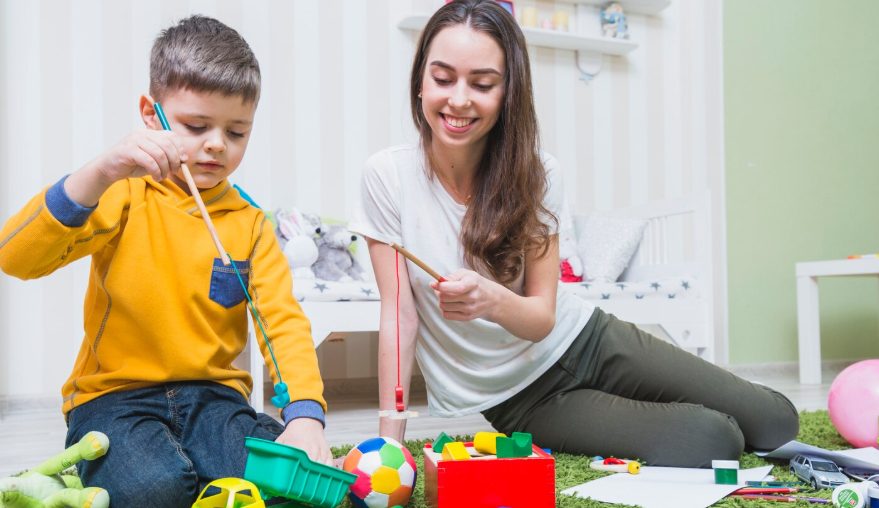
Parents often ask us: “How will I know if ABA therapy is working?” It’s a fair question, and it deserves a real answer.
ABA therapy progress in play-based learning looks like this:
- Your child starts requesting preferred toys instead of grabbing or melting down
- They begin imitating actions during play, stacking blocks the way a peer does
- They tolerate turn-taking for longer and longer periods
- They start to engage in functional play, feeding a doll, cooking in a play kitchen, and fixing toy cars
- Eventually, they move toward symbolic play, pretending a box is a spaceship, because their imagination is blooming
ABA progress monitoring ensures none of these steps go unnoticed. At EAV, we use data-driven tracking systems that give you a clear, visual picture of your child’s journey. Because every step forward, however small, is worth celebrating loudly.
Studies published in the Journal of Autism and Developmental Disorders consistently show that early, intensive autism ABA therapy leads to measurable, lasting improvements in play, language, and social skills. The earlier the intervention, the stronger the outcome.
Ready to see real progress? Request your free ABA therapy assessment at EAV.
Simple Ways to Use Play as a Teaching Tool at Home
You don’t need a therapy room to support your child’s play skills. Here are a few research-backed, BCBA-approved strategies you can try right now:
- Follow Their Lead
Let your child choose the activity. Your job is to join in and slowly expand the play, add a new character, introduce a new step, and offer a choice.
- Narrate the Play
Talk through what’s happening as you play. “The truck is going fast! Now it’s going slow.” This builds language naturally and without pressure.
- Use Positive Reinforcement
When your child engages in a new play behavior, clap, cheer, or give them something they love. Make it feel like the best thing that happened all day (because it is). This is positive reinforcement in its most natural, joyful form.
- Create Predictable Play Routines
Children with autism often thrive on predictability. A “playtime routine”, same toys, same sequence, same place, builds comfort and gradually allows for new skills to be introduced.
- Imitate Your Child First
Before teaching your child to imitate you, try imitating them. Mirror their actions, their sounds, their play. This builds connection and sets the stage for reciprocal interaction.
These strategies align closely with how does ABA therapy work in everyday contexts, using the child’s natural environment and motivation to drive skill development.
The Bottom Line: Play Is Never “Just Play”
Every block your child stacks, every pretend tea party they host, every game of chase, these are classrooms. They are opportunities. They are, in the truest sense, how your child learns to navigate the world.
For children with autism, play-based learning supported by autism ABA therapy gives those moments even more power. It turns “just playing” into intentional, joyful, measurable growth.
At Early Autism Ventures, we believe every child deserves to play, grow, and thrive, and we’re here to make sure that happens.
We’ve seen children who barely engaged with toys transform into creative, communicative, confident kids. We’ve watched families go from overwhelmed to empowered.
And we’re ready to do the same for yours.
Don’t wait to see what your child is capable of. Every day is a new opportunity to learn, connect, and grow, and with the right support, the possibilities are extraordinary.
Book your FREE consultation with EAV today, because your child’s journey starts with one conversation.