

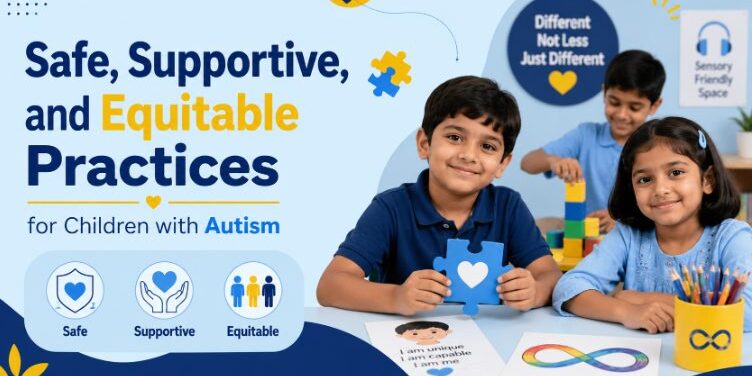
Every child with autism deserves to feel safe. Not just physically safe. Emotionally safe. Socially safe. Safe enough to learn, to express, to simply be.
Yet for millions of families across India, creating that safety is a daily challenge. It requires the right knowledge, the right environment, and the right people around the child.
This article breaks down what safe, supportive, and equitable practices for children with autism actually look like in practice. Whether you are a parent in Mumbai, a schoolteacher in Pune, or a therapist in a smaller town, this guide is for you.
What Does “Safe, Supportive, and Equitable” Actually Mean for Autistic Children?
These three words carry real weight. They are not just policy language.
Safe means the child is protected from physical harm, emotional distress, and environments that overwhelm their nervous system. It means no punishment for stimming. No forced eye contact. No sensory overload without a way out.
Supportive means every adult in the child’s life has the knowledge and tools to help that child thrive. It means communication strategies are in place. It means meltdowns are responded to with calm, not criticism.
Equitable means the child gets what they specifically need, not a one-size-fits-all approach. A child with autism may need more structured support, a quieter classroom, or an AAC device. Equity recognises that equal treatment is not always fair treatment.
Together, these three principles form the foundation of high-quality autism care.
The Legal Foundation: What Indian Law Says
India’s legal framework for children with autism has strengthened significantly in recent years.
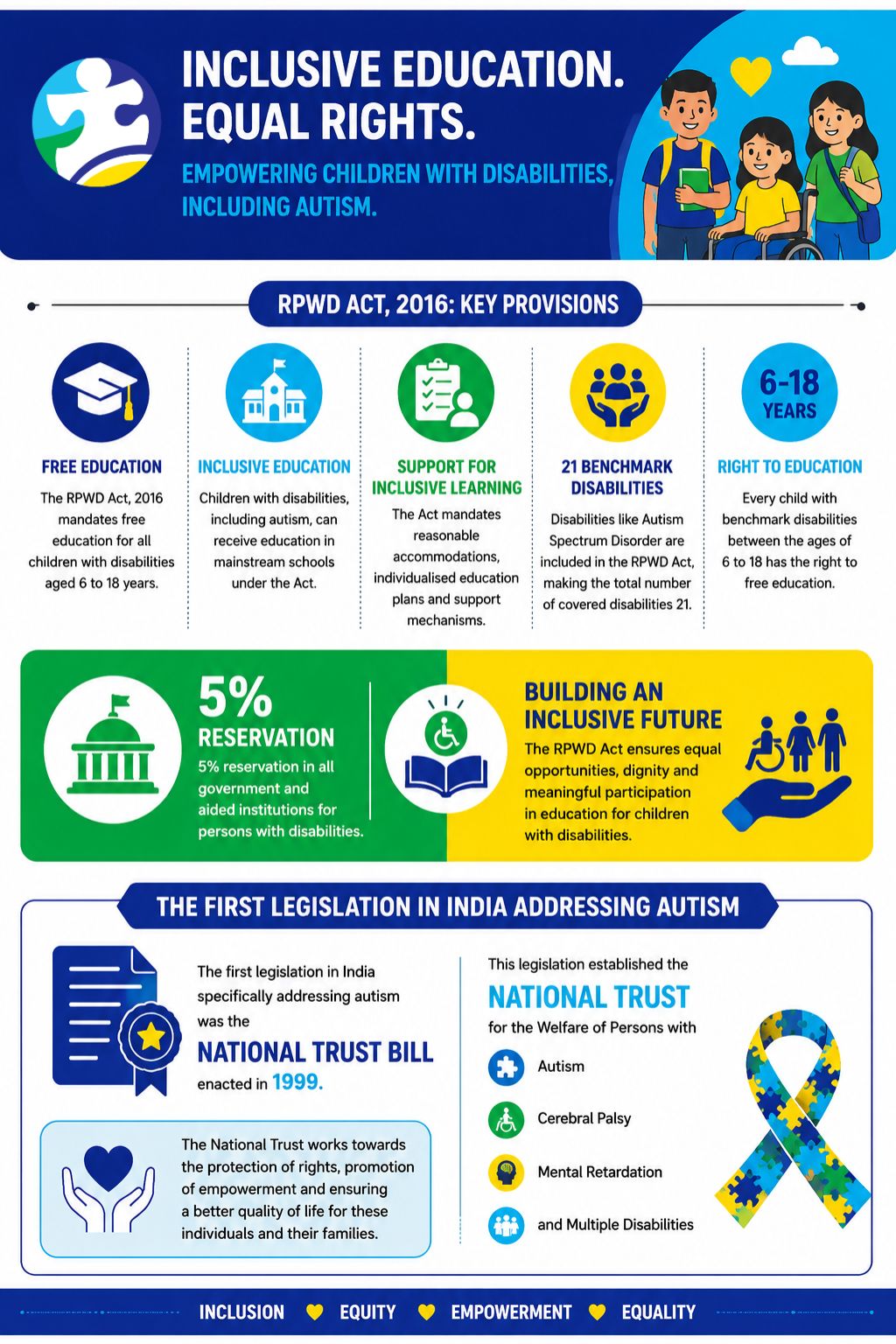
The Rights of Persons with Disabilities (RPWD) Act 2016 mandates free education for all children with disabilities aged 6 to 18, and children with disabilities, including autism, can receive education in mainstream schools under the act. The act mandates reasonable accommodations, individualised education plans, and support mechanisms for inclusive learning.
Disabilities like autism spectrum disorder are included in the RPWD Act, making the total number of covered disabilities 21, and every child with benchmark disabilities between the ages of 6 to 18 has the right to free education, along with 5% reservation in all government and aided institutions.
The first legislation in India specifically addressing autism was the National Trust Bill, which established the National Trust for the Welfare of Persons with Autism, Cerebral Palsy, Mental Retardation, and Multiple Disabilities.
On World Autism Awareness Day 2025, the Ministry of Education reaffirmed its commitment to inclusive education by strengthening support systems for children with ASD in schools. Through Block Resource Centres (BRCs), the government is ensuring that children with ASD receive essential therapy services, specialised interventions, and learning support.
Knowing your child’s legal rights is the first step to claiming them.
Core Principle 1: Create a Sensory-Safe Environment
For many autistic children, the world is a sensory minefield. Fluorescent lights flicker. School bells screech. Classroom smells compete. Fabric textures scratch. These are not imagined discomforts. They are neurological realities.
It is now recognised that ASD is related to sensory processing disorder, and sensory integration is considered a suitable intervention for treating children diagnosed with ASD.
Creating a sensory-safe environment means making deliberate choices about what a child’s physical surroundings look, sound, feel, and smell like.
Practical steps for homes and classrooms:
Reduce visual clutter. Cluttered walls and busy displays can be overwhelming. Use neutral tones and minimal decoration in the child’s primary learning or resting space.
Manage sound. Loud, unpredictable noise is one of the most common sensory triggers. Use noise-cancelling headphones during high-stimulation periods. Warn the child before transitions. If possible, offer a quiet corner or sensory retreat.
Consider lighting. Fluorescent lighting can cause discomfort. Natural light or warm LED alternatives are far more sensory-friendly.
Offer sensory tools. Fidget tools, weighted blankets, chew necklaces, and sensory cushions are not indulgences. They are functional supports that help children regulate their nervous systems.
School physical environments enable inclusion through flexible seating options and working patterns within classrooms that support sensory needs, smaller class sizes that promote collaborative working, and safe spaces for autistic children to seek time alone.
The goal is not to eliminate all stimulation. It is to give the child control over their sensory experience.
Core Principle 2: Use Neurodiversity-Affirming Communication
How you communicate with an autistic child matters enormously. And the shift required is often simpler than people expect.
Neurodiversity-affirming communication starts with one belief: the child is not broken. They are wired differently. That difference deserves respect.
What this looks like in practice:
Use plain, direct language. Idioms, sarcasm, and ambiguous instructions confuse many autistic children. Say exactly what you mean. “Please sit down now” is clearer than “Can you settle down?”
Give processing time. Many autistic children need longer to process verbal information. Pause after instructions. Do not interpret silence as defiance.
Use visual supports. Visual schedules, picture cards, and social stories give structure and predictability. They reduce anxiety and increase independence.
Respect all communication forms. Some children communicate through speech. Others use gestures, pictures, typing, or AAC (Augmentative and Alternative Communication) devices. All of these are valid. Non-speaking does not mean non-thinking.
Never force eye contact. Eye contact is not a marker of respect or attention for many autistic individuals. Demanding it causes distress and serves no therapeutic purpose.
Effective communication strategies are among the most essential components of best-practice care for children with ASD, particularly in high-stress situations where their sensory sensitivities and communication differences are heightened.
Core Principle 3: Implement Evidence-Based Interventions
Not all therapies are created equal. Safe, equitable autism care means choosing interventions that are evidence-based, child-led where possible, and free from punishment.
The multidisciplinary approach to autism intervention recommended by Indian clinical guidelines involves developmental paediatricians, psychologists, speech therapists, occupational therapists, physiotherapists, and special educators.
Recommended evidence-based approaches:
Applied Behaviour Analysis (ABA) when delivered in its modern, naturalistic form, focuses on skill-building in real-world contexts rather than rote compliance training. Look for ABA that is positive reinforcement based and child-centred.
Methods supported by research, like structured teaching (TEACCH), Applied Behavior Analysis (ABA), use of visual aids, individual educational programs, and the use of assistive technology, are very effective for autistic learners.
Speech and Language Therapy addresses communication across all modalities, not just spoken language. A good SLT will work on functional communication, not just articulation.
Occupational Therapy addresses sensory integration, fine motor skills, and daily living activities.
Ayres Sensory Integration Intervention (ASI) is a widely used approach in the treatment of ASD and has been the subject of growing systematic evidence supporting its effectiveness.
Early intervention matters most. Research consistently shows that early intervention dramatically improves outcomes for children with autism. Early diagnosis and structured intervention can significantly improve communication skills, social interaction, and adaptive behaviour.
What to avoid: Any intervention that relies on aversive techniques, restraint, isolation as punishment, or shame. These are harmful. They are also increasingly recognised as rights violations under Indian law.
Core Principle 4: Build Predictability and Structure
Uncertainty is one of the biggest sources of anxiety for autistic children. Routines are not rigidity. They are safety.
When a child knows what is coming next, their nervous system calms. Their capacity to engage, learn, and connect increases dramatically.
Practical strategies:
Use visual timetables. A picture-based daily schedule posted at eye level gives the child a roadmap of their day. Include transitions, meal times, therapy sessions, and free time.
Give advance notice of changes. Change cannot always be avoided. But it can be prepared for. Tell the child about upcoming changes as early as possible, and use social stories to walk them through what will happen.
Create consistent routines for meals, bedtime, and transitions. Consistency is not about rigidity for its own sake. It is about giving the child the cognitive bandwidth to engage with the world rather than spend all their energy managing anxiety.
Use first-then language. “First we do math, then we go outside.” Simple, predictable, manageable.
Core Principle 5: Ensure Equitable Access to Support in India
Equitable care means every child, regardless of geography, family income, or social background, gets what they need.
Equitable access to care must be a national priority. Expertise in ASD diagnosis and therapy is concentrated in urban centres, leaving rural and underserved populations with limited options.
This is the uncomfortable truth about autism care in India today. If your family lives in Mumbai or Bengaluru, access is vastly easier than if you live in a small town in Maharashtra or Bihar.
Closing this gap requires action at multiple levels.
For families: Seek out government-funded services through Block Resource Centres, Samagra Shiksha, and the National Trust. Know your child’s rights under the RPWD Act. Pursue a disability certificate, which unlocks access to a range of government benefits and educational accommodations.
For schools: Invest in teacher training on autism awareness. In India, even though there are supportive laws like the Rights of Persons with Disabilities Act (2016) and the National Education Policy (2020), full implementation is lacking due to insufficient teacher training, poor infrastructure, and socio-cultural barriers.
For policymakers and organisations: Digital interventions and tele-therapy offer a genuine route to equitable access. Digital interventions must be formally integrated into national health strategies through scalable, evidence-based models, particularly under frameworks like the WHO’s Nurturing Care for Early Childhood Development.
Core Principle 6: Centre the Family, Not Just the Child
Autism does not happen to a child in isolation. It happens within a family. Parents, siblings, grandparents, and caregivers are all part of the picture.
Safe, supportive care must extend to the people who love and raise the child.
What family-centred support looks like:
Parent training programs that build concrete skills, from managing meltdowns to teaching functional communication, reduce caregiver stress and improve child outcomes.
Access to respite care. Caregiving is exhausting. Parents need rest. Respite care is not a luxury. It is a basic support that enables long-term, sustainable care.
Peer support networks. Connecting with other autism families reduces isolation. Sharing knowledge, navigating systems together, and simply being understood matters.
Culturally sensitive support. In the Indian context, stigma remains a barrier. Families may face pressure from extended family or community. Effective support acknowledges this reality and does not add to the burden.
Core Principle 7: Embrace a Strengths-Based Lens
Every child with autism has strengths. Every single one.
Safe, equitable practice means actively identifying and building on those strengths, not just cataloguing deficits.
Some autistic children have exceptional visual memory. Others have deep, intense interests that can be leveraged for learning and connection. Others show extraordinary attention to detail, pattern recognition, or creative thinking.
A strengths-based approach does not ignore challenges. It contextualises them within a fuller picture of who the child is.
Provider knowledge of the child’s strengths and understanding of autism are key to inclusion of the autistic child, while lack of awareness of the child’s support needs leads to exclusion.
When a child sees themselves reflected in the goals of their therapy and education, when they feel their interests are respected and their abilities are celebrated, outcomes improve. So does their sense of self.
The Role of Early Identification in India
You cannot provide the right support without knowing what a child needs. And that starts with identification.
Key early signs that parents and caregivers should watch for between 18 and 24 months include difficulties in social interaction, challenges in verbal and non-verbal communication, and repetitive behaviours. Screening tools validated for Indian populations include the Modified Checklist for Autism in Toddlers (M-CHAT), the Trivandrum Autism Behavioral Checklist (TABC), and the Indian Scale for the Assessment of Autism (ISAA), which is widely used across Indian clinical settings.
If you have concerns about your child’s development, do not wait. Early identification leads to early intervention. And early intervention changes outcomes.
Speak to your paediatrician. Seek a developmental evaluation. Trust your instincts as a parent.
What Equitable Practice Looks Like in a Therapy Setting
An equitable therapy environment is designed with the whole child in mind. Here is what to look for when choosing a therapy provider for your child:
The therapist respects the child’s communication style and does not force compliance.
Goals are individualised, functional, and co-created with the family.
Progress is measured meaningfully, not just in terms of how “normal” the child appears.
The environment is sensory-accessible.
The team communicates with the family regularly, clearly, and without jargon.
Cultural context is acknowledged. Indian families may navigate extended family dynamics, financial constraints, and community stigma that shape what support looks like.
The child is treated with dignity at all times.
Frequently Asked Questions
What are the most important practices for keeping autistic children safe at home?
The most important practices include creating a sensory-safe environment, using predictable daily routines, communicating clearly and directly, having a plan for meltdowns that does not involve punishment, and ensuring the home is physically safe by addressing elopement risks and sensory hazards.
What does neurodiversity-affirming care mean for autistic children in India?
Neurodiversity-affirming care means treating autism as a neurological difference rather than a disorder to be fixed. It involves building on the child’s strengths, respecting all forms of communication, avoiding harmful or aversive practices, and ensuring the child is included in decisions about their own life and learning.
What legal rights do children with autism have in India?
Under the RPWD Act 2016, children with autism have the right to free education between ages 6 and 18, reasonable accommodations in school, a disability certificate, access to government rehabilitation services, and protection from discrimination. The National Trust Act 1999 also provides guardianship and welfare provisions for persons with autism.
How can I find autism support services in Mumbai or other Indian cities?
Start with a developmental paediatrician for diagnosis and referral. Look for occupational therapists, speech therapists, and special educators with autism experience. Organisations like Early Autism Ventures provide structured early intervention. The National Trust and government BRCs also provide access to therapy services, particularly for families with limited financial resources.
What is the difference between supportive and safe autism practices?
Safe practices focus on protecting the child from harm, including sensory harm, emotional distress, and abusive interventions. Supportive practices focus on actively building the child’s skills, confidence, and independence through evidence-based methods, consistent routines, and positive relationships. Together, they create the conditions for a child to genuinely thrive.
Conclusion: Every Child Deserves to Thrive
Safe, supportive, and equitable practices for children with autism are not aspirational ideals. They are achievable realities.
They require knowledge. They require consistency. They require a willingness to see the child in front of you fully, strengths and all.
In India, the legal framework exists. The evidence base exists. What families need is access to the right support and the right information.
That is what Early Autism Ventures is here for.

Want to know more? Visit https://eav.gowidetechnologies.com/ or Call +91 89291 53820