

Every parent remembers the big milestones. The first roll, the first wobbly step, the first time a spoon actually made it to the mouth instead of the ear.
What almost nobody tells you about is a quieter milestone happening underneath all of that: reflex integration.
But what is reflex integration? It is the unglamorous, un-photographed process where a baby’s automatic, hardwired reflexes fade into the background so that controlled, voluntary movement can take charge.
Think of primitive reflexes as your baby’s factory-installed apps. They come pre-loaded, they help with survival in the first few months, and then, ideally, they get “updated” and phased out as the brain matures.
When that update does not fully install, the old apps keep running quietly in the background, draining battery and occasionally freezing the whole system.
For children with autism and other neurodevelopmental conditions, incomplete reflex integration often shows up as sensory issues in children, clumsiness, poor handwriting, or a meltdown that seems to come out of nowhere.
This blog is your one-stop guide to reflex integration and child development — what it is, why it matters, and how the right occupational therapy for kids, alongside ABA therapy, can help your child move forward, literally and figuratively.
We will also walk you through how Early Autism Ventures (EAV) approaches this, so you know exactly what support looks like when you are ready to ask for it.
What Are Primitive Reflexes, Really?
Primitive reflexes are automatic movements every baby is born with. They entail reactions that fire without any conscious thought, controlled by the most primal part of the brain, the brainstem.
The Moro reflex makes a baby fling out both arms at a sudden noise.
The Asymmetrical Tonic Neck Reflex (ATNR) turns a baby’s head to one side while the arm on that side shoots out, like a tiny fencer mid-lunge.
The Spinal Galant reflex makes a baby wriggle when you stroke along their lower back — handy for the journey through the birth canal, less handy years later when it resurfaces as a child who simply cannot sit still in class.
These reflexes are meant to integrate, meaning they get absorbed into more mature, voluntary movement, within roughly the first year of life as higher brain centers take over.
Researchers have even built formal measurement tools, such as the Children’s Primitive Reflex Integration Measurement Scale, because non-integrated reflexes are so closely tied to motor function and psychological wellbeing in children
When integration stays incomplete, therapists call it a “retained primitive reflex,” and it is far more than a quirky footnote. In fact, it can quietly shape how a child moves, sits, focuses, and regulates emotions for years. This is exactly the territory that child development therapy is built to address.
Signs Your Child Might Have Retained Reflexes
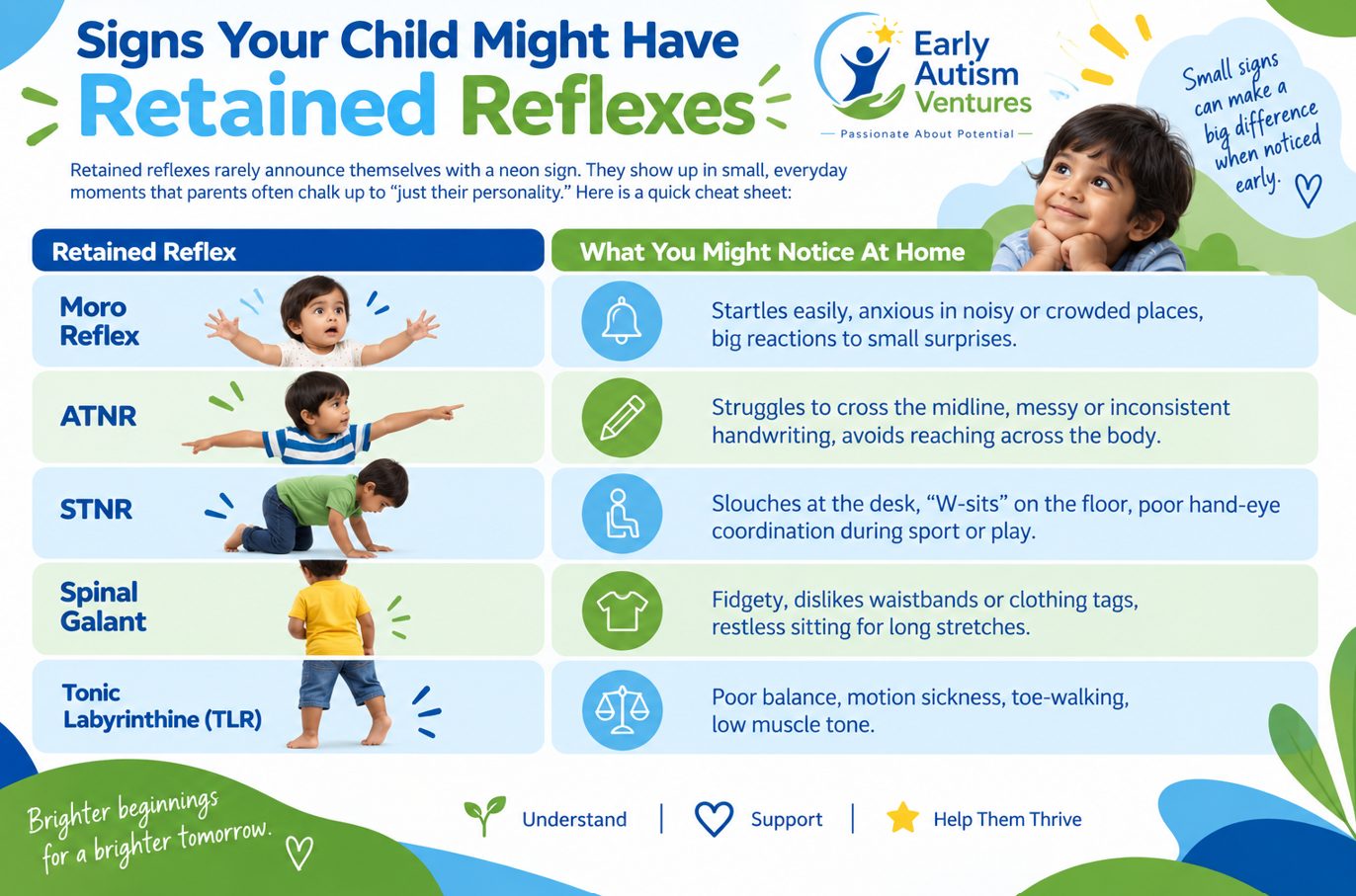 Retained reflexes rarely announce themselves with a neon sign. They show up in small, everyday moments that parents often chalk up to “just their personality.” Here is a quick cheat sheet:
| Retained Reflex | What You Might Notice At Home |
|---|---|
| Moro Reflex | Startles easily, anxious in noisy or crowded places, big reactions to small surprises |
| ATNR | Struggles to cross the midline, messy or inconsistent handwriting, avoids reaching across the body |
| STNR | Slouches at the desk, “W-sits” on the floor, poor hand-eye coordination during sport or play |
| Spinal Galant | Fidgety, dislikes waistbands or clothing tags, restless sitting for long stretches |
| Tonic Labyrinthine (TLR) | Poor balance, motion sickness, toe-walking, low muscle tone |
A little humour helps here: if your child treats a simple worksheet like an Olympic balance-beam event, complete with wobbling, sighing, and the occasional dramatic collapse onto the desk, retained reflexes might genuinely be part of the plot.
This is also where sensory issues in children, fine motor skills activities, and gross motor skills therapy enter the conversation. This is because the same immature reflex patterns that affect balance also affect pencil grip, scissor skills, and the ability to sit upright through story time.
The Sensory-Autism Connection
For children on the spectrum, this picture gains an extra layer. Research on persistent primitive reflexes points to a link with neurodevelopmental delays such as learning disabilities, autism spectrum disorder, and broader processing difficulties.
A separate study on preschool-aged children found that a higher number of active primitive reflexes lined up with sensory difficulties that parents themselves had already noticed at home.
So if your gut has been telling you something is going on with how your child processes touch, sound, or movement, the science tends to agree with your instinct — which is exactly why sensory processing disorder therapy exists.
More recent research combining rhythmic movement with balance and whole-body coordination work has shown reduced reflex retention and improved behavioural outcomes in children with autism and ADHD (Move Play Thrive, Hirose et al., 2025).
This is precisely the kind of motor planning activities and balance and coordination therapy that a skilled OT for autism weaves into a session disguised as play, because let’s be honest. No five-year-old is signing up to “do reflex integration homework” unless it looks suspiciously like a game.
How Occupational Therapy Helps Integrate Reflexes
This is where pediatric occupational therapy earns its keep. A qualified occupational therapist does not simply hand your child a colouring sheet and call it a day, although there will be plenty of art, because children love it and it sneaks in reflex-integration work without them ever clocking that they are “doing therapy.”
A proper OT assessment for children starts by identifying which specific reflexes are still active, then builds a targeted integration plan where every activity maps back to the reflex it is helping to retire:
- Sensory Integration Therapy: for an overactive Moro reflex, structured input such as swinging, brushing, deep pressure, and textured play helps the nervous system stop overreacting to every touch, sound, or surprise
- Motor Planning Activities: for a lingering ATNR, obstacle courses, animal walks, and balance-beam games ask the brain and body to cross the midline and sequence movement — the exact skill this reflex interferes with
- Gross Motor Skills Therapy: for a retained STNR or TLR, climbing, jumping, and coordination work rebuilds the postural control those reflexes were still overriding, so a child can sit, stand, and move with confidence
- Fine Motor Skills Activities: once ATNR integration is underway, pencil-grip work, cutting, and threading translate that new midline control into real handwriting improvement therapy
- Balance and Coordination Therapy: wobble boards, therapy balls, and swings target a retained TLR head-on, calming the overactive vestibular response behind poor balance and motion sickness
- ADL Training: brushing teeth, buttoning shirts, and using cutlery become far less of a daily battle once the Spinal Galant and ATNR reflexes that were quietly sabotaging them are finally integrated
- Feeding Therapy For Kids: an overactive gag or rooting reflex is often part of the same retained-reflex picture, so feeding therapy is folded into the plan rather than treated as a separate issue
Every one of these activities exists to move a specific reflex further along the integration timeline, not just to keep a child busy. That is what turns “my child struggles with X” into real, trackable progress. And it is also how school readiness skills, like sitting still, holding a pencil, or following multi-step instructions, show up almost as a side effect once the underlying reflexes stop getting in the way.
Why ABA and OT Work Better Together
Let’s bust a common myth: parents often think they must choose between ABA therapy and occupational therapy.
You do not. They are teammates, not rivals.
ABA therapy focuses on teaching functional skills and reducing challenging behaviour through positive reinforcement and data-driven methods, while occupational therapy for kids works on the physical and sensory foundation those skills sit on top of.
A systematic review of 33 randomised controlled trials, covering more than 2,500 children with autism, found that early interventions produced measurable gains in motor skills and daily living skills, with results that held up even under strict scientific scrutiny (PMC, 2022).
Pair that with the CDC’s own guidance that early intervention services can significantly improve a child’s developmental trajectory (CDC), and the case for starting early, and starting with both ABA and OT together, more or less writes itself.
At Early Autism Ventures, we do not make you choose. Our behaviour technicians, QBAs, BCBAs, occupational therapists, and speech therapy team work as one coordinated group, so your child’s therapy for neuro developmental kids addresses behaviour, communication, sensory regulation, and motor skills together rather than in separate silos that never talk to each other.
Whether your child needs ABA therapy, speech therapy, occupational therapy for kids, or all three woven into a single plan, that coordination is what makes early intervention therapy actually work in the real world, not just on paper.
What to Expect from an EAV Occupational Therapy Assessment
If you have typed “occupational therapist in Bangalore” or “occupational therapy near me” into a search bar at 11 pm after a particularly rough bedtime battle, we see you, and you are far from alone.
Every EAV journey begins with a thorough OT assessment for children: our therapists observe posture, coordination, sensory responses, and yes, primitive reflex activity, to build a plan that is genuinely personalised rather than generic.
From there, we design a mix of in-clinic sessions and an OT home program for kids, so the progress made in a forty-five-minute session does not evaporate the moment you walk out the door.
Parents leave with simple, practical activities, often disguised as games, to reinforce behavioural and sensory regulation at home — a laundry-basket “swing,” a texture treasure hunt, or a five-minute animal-walk relay before dinner. With centres across Bangalore and Hyderabad, and both in-home and centre-based options, getting started is easier than most parents expect.
Based in Hyderabad or Bengaluru and searching for the right fit? Let’s talk about what a plan for your child could look like.
The Takeaway
Parenting a child with sensory challenges, retained reflexes, or a neurodevelopmental diagnosis can feel like assembling flat-pack furniture with half the instructions missing while someone in the back seat keeps asking “are we there yet?”
But here is the encouraging part: reflex integration is trainable, sensory systems are adaptable, and children, especially young ones, respond remarkably well to the right support delivered at the right time.
You do not need every answer today. You just need one small, brave next step, and that step can be as simple as a conversation with a team that has walked this road with hundreds of families before yours.
How Early Autism Ventures Can Help Your Child
At Early Autism Ventures, our occupational therapists treat reflex integration as a genuine starting point, not an afterthought. Every child’s plan begins with a real OT assessment for children that specifically screens for retained primitive reflexes, alongside posture, coordination, and sensory responses, so we know exactly which reflexes are still active before a single activity is planned.
From there, therapy grows through targeted sensory integration therapy, motor planning activities, and balance and coordination therapy designed to help those reflexes finally integrate, easing the sensory issues in children, clumsiness, and handwriting struggles that so often trace back to them, all wrapped in genuine warmth and a lot of patience.
Whether you are looking for OT for autism, support for sensory processing disorder therapy, or an occupational therapist in Bangalore or Hyderabad who actually checks for retained reflexes instead of guessing at the cause, our team is ready to meet your family exactly where you are.
Your child’s breakthroughs are waiting. Don’t let another week pass wondering “what if.” Schedule your free consultation with Early Autism Ventures today and let’s take that first step together — because every child deserves the chance to move, learn, and grow with confidence.