
When your child knows what they want to say but just can’t get the words out, here’s what’s really going on, and what you can do about it.
You’ve watched your child try. Their eyes light up with something to say, their mouth opens. But then nothing comes out right. Or maybe sounds come out jumbled, unclear, or frustratingly inconsistent. One day they say a word perfectly. The next day, it’s gone.
If this sounds familiar, your child may be experiencing sensory motor difficulties in speech. It is a very real, very treatable challenge that affects thousands of children, particularly those on the autism spectrum or with neurodevelopmental conditions.
Now, take a breath. You’re in the right place. Let’s talk about what’s actually happening in your child’s brain and body, and how pediatric speech therapy can boost communication in ways that might genuinely surprise you.
What Are Sensory Motor Difficulties in Speech?
Speech is deceptively complex. To say a single word, your child’s brain must:
- Plan the movement sequence (motor planning)
- Send signals to over 100 muscles in the face, jaw, lips, and tongue
- Process sensory feedback; how it feels, sounds, and vibrates
- Adjust in real time based on that feedback
When any part of this loop breaks down, speech becomes difficult. And this is not because the child doesn’t have ideas or intelligence, but because the sensory-motor pathway isn’t working efficiently.
This is why sensory motor speech disorders are so often misunderstood. A child who stumbles over words isn’t being lazy or difficult. Their brain is working overtime just to produce sounds that most of us take entirely for granted.
Schedule Your Free Consultation with Early Autism Ventures Now.
Common Sensory Motor Speech Disorders in Children
- Childhood Apraxia of Speech (CAS)
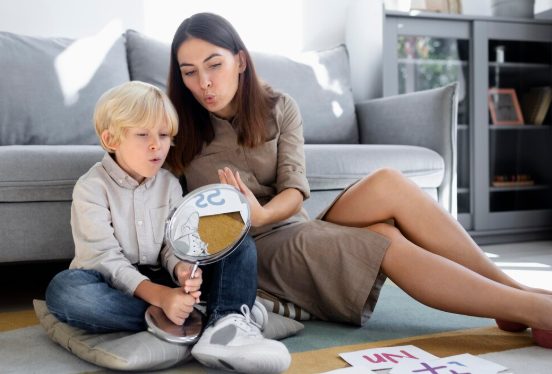
One of the most well-known motor speech disorders in children, CAS occurs when a child has difficulty planning and coordinating the precise movements needed for speech. Words may come out differently each time. The child knows what they want to say, the message is clear in their mind, but the motor program keeps misfiring.
Research from the Apraxia Kids organization estimates CAS affects approximately 1–2 children per 1,000, with significantly higher rates in children with autism. Speech therapy for apraxia is the primary treatment, with intensive, repetition-based motor practice showing the strongest outcomes.
- Dysarthria
Dysarthria in children results from weakness or poor coordination of the muscles used for speech. It often occurs alongside cerebral palsy, Down syndrome, or other neurological conditions. Speech may sound slurred, slow, or “mushy.” Speech-language therapy addresses muscle strength, breath support, and articulation in an integrated way.
- Sensory Processing and Speech
Children with sensory processing difficulties often struggle with the auditory and tactile feedback that shapes speech. If a child can’t clearly “feel” or “hear” how their sounds are landing, they can’t self-correct effectively. This is particularly relevant in speech therapy for autism, where sensory dysregulation and communication difficulties frequently co-occur.
A recent study published in the Journal of Autism and Developmental Disorders found that sensory processing differences were present in over 90% of children with autism, and significantly impacted their speech and communication development.
- Oral Motor Difficulties
Oral motor therapy targets the muscles of the mouth, jaw, lips, and tongue. When these muscles lack strength, coordination, or sensory awareness, it directly impacts articulation disorders in children, feeding, and even breath control for speech. Many children who receive feeding therapy also benefit from oral motor work that carries over into clearer speech.
Red Flags: When Should You Seek a Speech Therapy Evaluation?
Parents often sense something is off before anyone else does. Trust that instinct. Here are signs that warrant a speech-language evaluation for children:
– Your child isn’t babbling by 12 months
– No single words by 16 months
– No two-word combinations by 24 months
– Speech is difficult to understand, even for family members
– Your child loses speech skills they previously had
– Inconsistent sound production (says a word once, then can’t repeat it)
– Avoids talking or becomes frustrated when trying to communicate
– Difficulty imitating mouth movements or sounds
– Drooling beyond typical age ranges, or difficulty chewing
The American Speech-Language-Hearing Association (ASHA) recommends early evaluation whenever a parent has concerns, because early speech intervention is significantly more effective than waiting for a child to “grow out of it.”
(Spoiler: they usually don’t grow out of it on their own. But they absolutely can grow through it, with the right support.)
How Does Pediatric Speech Therapy Actually Work?
Great question, and one every parent deserves a clear answer to.
Pediatric speech therapy is delivered by a Speech-Language Pathologist (SLP), a licensed professional trained to assess and treat communication disorders across all ages. For sensory motor speech difficulties, therapy is highly individualized and evidence-based.
Here’s what a typical approach looks like:
Step 1: Comprehensive Speech-Language Assessment
A thorough speech and language assessment for kids examines articulation, phonology, oral motor function, language comprehension, expressive language, fluency, voice, and sensory responses. This isn’t a one-size-fits-all checklist, it’s a detailed map of your child’s unique communication profile.
Step 2: An Individualized Therapy Plan
Based on assessment findings, the SLP designs goals targeting your child’s specific challenges, whether that’s motor speech therapy, language development, augmentative and alternative communication (AAC), or a combination.
Step 3: Intensive, Repetitive Practice
For motor speech disorders like CAS, intensive speech therapy for children with high repetition is the gold standard. The brain learns movement through practice, lots of it. The good news? Skilled SLPs make this practice engaging, playful, and rewarding.
Step 4: Progress Monitoring and Family Training
Speech therapy progress monitoring ensures goals are regularly reviewed and updated. And critically, parents are trained to reinforce skills at home. Because the SLP sees your child for an hour. You have the other 23.
The Role of Sensory Integration in Speech Development
Here’s something many parents don’t realize: sensory integration therapy and speech therapy are deeply connected.
The mouth is one of the most sensory-rich areas of the human body. Children with sensory processing disorder may be hypersensitive (over-responsive) or hyposensitive (under-responsive) to oral sensations, and both affect speech production.
Sensory-based speech therapy uses tactile cues, vibration, temperature, and proprioceptive input to help children “feel” their speech movements more clearly. Combined with traditional motor practice, this approach is particularly effective for children with autism and sensory motor challenges.
Think of it like recalibrating the GPS before asking someone to drive. First, we fix the signal. Then, the route becomes clear.
Speech Therapy and Autism: What the Research Says
For children on the autism spectrum, speech therapy for autism is one of the most impactful interventions available. Communication difficulties are a defining feature of autism, and they look different in every child, from non-speaking children to those with strong vocabularies but pragmatic language challenges.
We did the ground-work so you don’t have to. Here’s what research says:
– A Cochrane Review found that early speech-language intervention for children with autism produced meaningful improvements in communication, social interaction, and quality of life.
– ASHA’s evidence maps confirm that augmentative and alternative communication (AAC), including devices, picture systems, and sign language, does not reduce a child’s motivation to develop verbal speech. In fact, it often supports it.
– The National Autism Center’s Standards Report identifies communication-focused behavioral interventions as among the most well-established treatments for autism.
The earlier autism speech therapy begins, the better. But it’s never too late to make meaningful progress, and that’s not just a hopeful phrase. It’s what the data shows.
Speech Therapy + ABA Therapy: A Powerful Team
While this blog is focused on speech, it’s worth mentioning that ABA therapy and speech therapy work beautifully together for children with autism and related conditions.
ABA therapy, delivered by a BCBA (Board Certified Behavior Analyst), uses positive reinforcement and systematic teaching to build communication skills alongside behavioral goals. Autism ABA therapy programs often include verbal behavior components that directly support speech therapy goals. When an SLP and a BCBA collaborate around shared communication objectives, children make progress faster and more consistently.
ABA therapy benefits in the area of communication are well-documented: improvements in requesting, labeling, following instructions, and social communication. ABA progress monitoring ensures every communication milestone is tracked and celebrated.
How Early Autism Ventures Supports Your Child’s Communication Journey
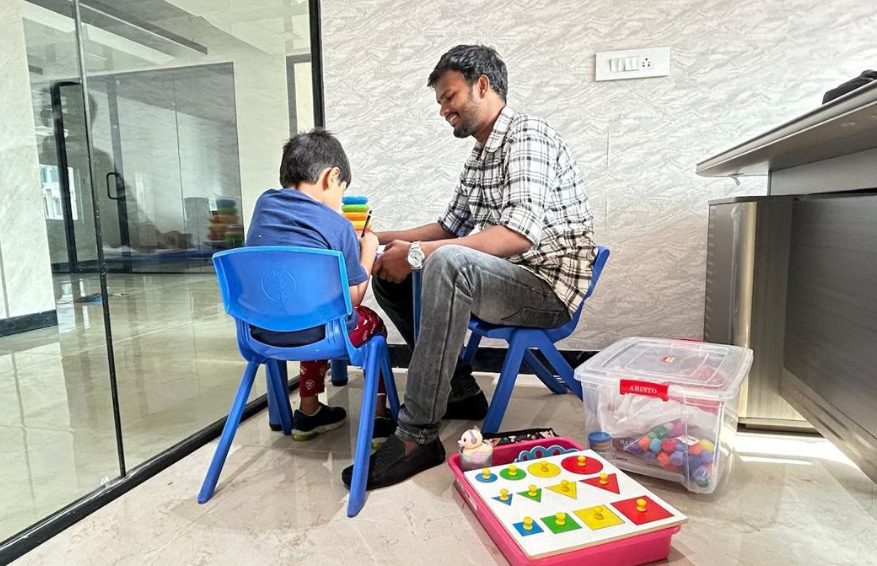
At Early Autism Ventures (EAV), we believe every child has something to say, and our job is to help them say it.
Our team of experienced Speech-Language Pathologists works alongside BCBAs and occupational therapists to create a truly integrated, child-centered approach to communication. Here’s what that looks like in practice:
- Comprehensive speech-language assessments that go beyond checklists to understand the whole child
- Specialized expertise in childhood apraxia of speech, sensory motor speech disorders, autism speech therapy, and AAC
- Oral motor therapy and sensory-based speech techniques for children with complex sensory profiles
- Close collaboration with our ABA therapy team to align communication goals across all settings
- A warm, play-based therapy environment where children actually want to come, (yes, we’ve had kids ask to skip birthday parties to attend therapy. We were flattered and slightly concerned.)
- Regular speech therapy progress monitoring with transparent reporting so parents always know where their child stands
- Practical home programs that make you part of the therapy team
At EAV, we don’t just treat speech. We build communicators. And we do it with the kind of care, precision, and genuine joy that makes a real difference in children’s lives.
Sensory motor speech difficulties are real, they are complex, and they are absolutely addressable. With the right assessment, the right therapy, and the right team behind your child, communication breakthroughs happen every single day.
At Early Autism Ventures, we see them happen. We celebrate them loudly. And we want that for your child too.
The first step is a conversation. Let’s have it.