
Pencil grip, posture, fine motor strength, visual tracking; well, the real reason some children struggle to write has nothing to do with effort, and everything to do with foundation.
Here’s something most parents don’t know until an occupational therapist tells them: writing is one of the most complex things a child’s body is ever asked to do.
Before a child can form a single letter, their brain and body need to have mastered dozens of underlying skills, skills most of us developed so naturally we never thought to give them a name. But for children with autism, developmental delays, sensory processing differences, or neurodevelopmental conditions, these foundational skills don’t always develop automatically.
That’s where occupational therapy for prewriting skills comes in. And no, prewriting is not the same as handwriting. Not even close. Let’s dig into what it actually is, why it matters so much, and how a skilled OT can build the groundwork that makes everything else possible.
What Are Prewriting Skills, Exactly?
Prewriting skills are the building blocks that must be in place before a child can successfully learn to write. They have nothing to do with letters or numbers. Instead, they cover the physical, sensory, perceptual, and cognitive abilities that make holding and controlling a pencil even possible.
Think of prewriting skills as the foundation of a house. You wouldn’t start hanging wallpaper before the walls are up. And you wouldn’t expect a child to write neatly before their hands, eyes, posture, and brain are ready to work together.
Prewriting skills include:

– Postural control and core strength, Can the child sit upright and stable long enough to work at a table?
– Shoulder and arm stability, Are the shoulder joints strong enough to support controlled hand movement?
– Fine motor skills, Can the child use their fingers with precision, strength, and coordination?
– Hand dominance, Has the child established a preferred hand?
– Bilateral coordination, Can both hands work together (one holding paper, one writing)?
– In-hand manipulation, Can the child move objects within their hand without using the other hand?
– Pencil grip development, Is the child holding a crayon/pencil in a way that allows control?
– Visual motor integration, Can the child coordinate what their eyes see with what their hands do?
– Visual perceptual skills, Can the child recognize shapes, lines, sizes, and spatial relationships?
– Prewriting shapes, Can the child copy lines, circles, crosses, and diagonal lines in the correct developmental sequence?
Each of these skills develops in a specific order, and if one is missing or weak, it creates a ripple effect through the rest. A child with poor core stability will compensate by using their shoulder. That tires the arm. That compromises grip. That makes lines shaky. And suddenly, everyone thinks the child “just doesn’t try hard enough.” (They do. They’re exhausted.)
Why Posture Comes Before Pencils
Let’s talk about something that gets almost no attention in conversations about writing: posture.
Before a child can write, they need to be able to sit. Not just sit, sit stably. That means an upright trunk, feet flat on the floor, hips at 90 degrees, and enough core endurance to maintain that position for 10, 20, 30 minutes at a time.
This is called postural control, and it’s a core area of pediatric occupational therapy.
When core strength is insufficient, children do what any sensible person would do, they compensate. They slump forward onto the desk. They wrap their legs around chair legs. They prop their head in their hands. They lean sideways. None of this is defiance. All of it is the body trying to find stability any way it can.
The problem? When a child is using all their energy just to stay upright, there’s very little left for the fine motor control that writing demands. Gross motor skills therapy and core strengthening exercises are often the very first things an OT addresses before ever touching a pencil.
Shoulder stability is equally important. The shoulder acts as a base, like a camera tripod. If the tripod is wobbly, no amount of skill with the camera will produce a clear picture. Shoulder strengthening activities, wall push-ups, wheelbarrow walking, carrying weighted items, build the proximal stability that allows the hand to move with control distally.
This is one of the most important principles in child development therapy: always build from the inside out. Core, then shoulder, then elbow, then wrist, then fingers.
Pencil Grip: It’s More Complicated Than You Think

Ask most parents what a “correct” pencil grip looks like, and they’ll describe a dynamic tripod grip, thumb, index finger, and middle finger. And yes, that’s the goal. But there’s a whole developmental journey between “fist grip” and “tripod grip,” and children need to travel that road at their own pace.
Pencil grip development follows a predictable progression:
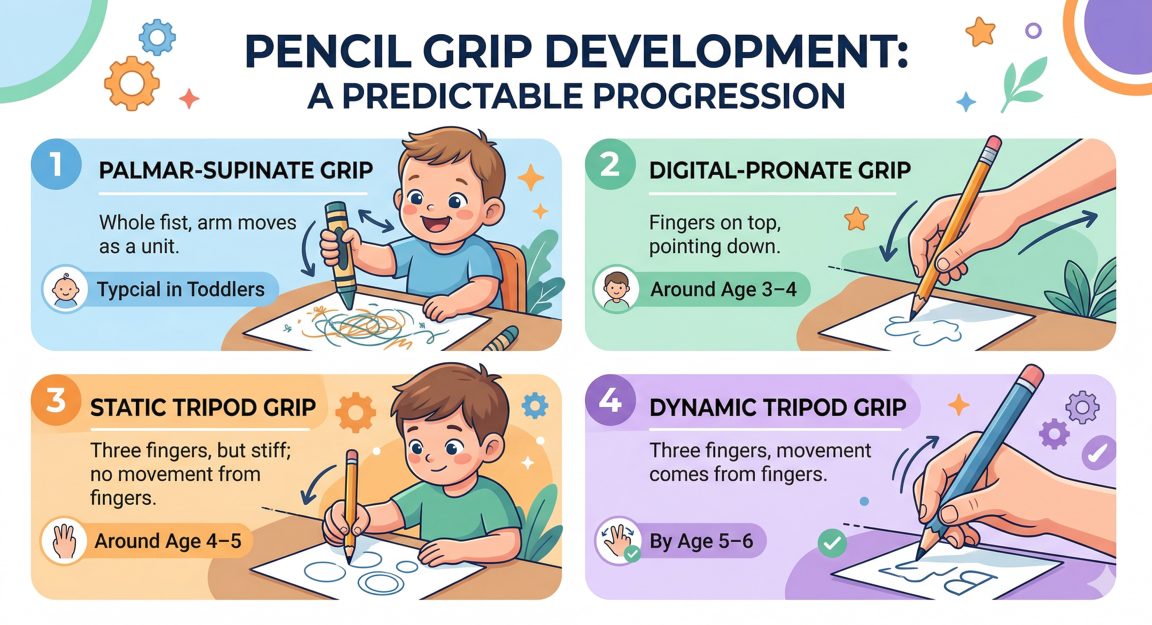
- Palmar-supinate grip (whole fist, arm moves as unit), typical in toddlers
- Digital-pronate grip (fingers on top, pointing down), around age 3–4
- Static tripod grip (three fingers, but stiff, no movement from fingers), around age 4–5
- Dynamic tripod grip (three fingers, movement comes from fingers), by age 5–6
Children with fine motor delays, low muscle tone, or sensory processing differences often get stuck at earlier stages. Or they develop compensatory grips that feel functional but cause fatigue and pain over time.
OTs address pencil grip through:
– Proprioceptive and tactile activities to improve sensory awareness in the hands
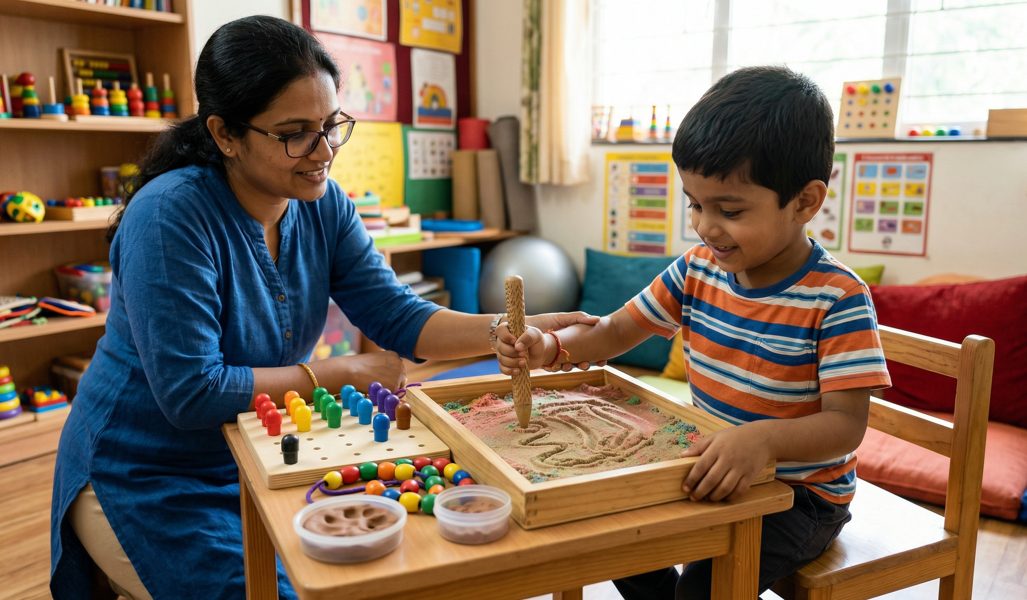
– Fine motor skills activities like playdough, lacing, threading beads, and pegs
– Adapted tools, triangular crayons, pencil grips, weighted pencils
– In-hand manipulation tasks, coin sorting, picking up small objects, moving items within the palm
One important note: grip correction works best when addressed early. Once a compensatory grip is habituated, usually by age 7–8, it becomes significantly harder to change. This is yet another reason why early intervention therapy matters so much.
Schedule Your Free Consultation with Early Autism Ventures Today
Fine Motor Skills: The Engine of Prewriting
If postural control is the foundation, fine motor skills are the engine. Fine motor development refers to the small, precise movements of the hands and fingers, and it encompasses far more than most parents realise.
Key fine motor skills for prewriting include:
- Hand strength: Children need adequate grip strength and pinch strength to hold and control a writing tool for extended periods. Weak hands fatigue quickly, leading to messy output and avoidance.
- Finger isolation: Can the child use one finger at a time independently? This is essential for controlled pencil movement.
- In-hand manipulation: The ability to move objects within the hand, rotating a pencil to use the eraser, for instance, requires sophisticated coordination that many children with sensory issues or low tone struggle with.
- Bilateral coordination: Writing requires one hand to hold the paper while the other writes. This sounds simple. For many children with motor planning difficulties, it is genuinely hard.
- Scissor skills: Cutting with scissors is both a fine motor skills activity and a prewriting readiness measure. It requires bilateral coordination, visual-motor control, and sustained hand strength all at once. A child who can cut along a line is building exactly the same skills they’ll use to form controlled strokes on paper.
A recent study found that pinch strength and in-hand manipulation skills in preschool-age children were significantly predictive of handwriting readiness at school entry.
Visual Motor Integration and Visual Perception: The Eyes Have It
Here’s a prewriting skill that surprises many parents: visual motor integration (VMI), the ability to coordinate visual information with hand movement, is one of the strongest predictors of writing success.
A child can have perfect grip and great core strength, but if their eyes and hands don’t communicate properly, their lines will be shaky, their shapes will be distorted, and copying from the board will be a nightmare.
Visual perceptual skills that underpin prewriting include:
– Visual discrimination, telling similar shapes apart
– Figure-ground perception, finding a shape within a complex background
– Spatial relations, understanding above/below, left/right, in/out
– Visual closure, recognising a shape even when part of it is missing
– Form constancy, recognising that a circle is a circle whether it’s big, small, tilted, or dotted
OTs assess these skills formally using tools like the Beery-Buktenica Developmental Test of Visual-Motor Integration (Beery VMI), a standardised assessment widely used in OT assessment for children. Identified weaknesses are then targeted through specific visual-motor activities, puzzles, mazes, dot-to-dot tasks, and tracing exercises.
Prewriting Skills in Children with Autism and Neurodevelopmental Conditions
For children on the autism spectrum or with other neurodevelopmental conditions, prewriting challenges are extremely common, and often multi-layered.
Sensory processing differences affect grip pressure (too hard, too soft), tolerance for tactile input from pencils and paper, and proprioceptive awareness of hand position. Children who are hypersensitive may find the sensation of writing uncomfortable. Those who are hyposensitive may press so hard they tear through the paper.
Motor planning difficulties (dyspraxia) affect the ability to sequence and execute the movements needed for shapes and strokes. A child with dyspraxia may know what a circle looks like but struggle to plan the hand movement required to draw one.
Low muscle tone, common in children with autism, Down syndrome, and hypermobility, affects grip strength, postural control, and endurance. Every stroke takes more effort than it should.
Behavioral and sensory regulation difficulties mean that by the time a writing task is presented, a child may already be dysregulated, and a dysregulated nervous system cannot learn fine motor skills. This is why OTs so often address sensory regulation before getting to the table.
ABA therapy, delivered by a BCBA (Board Certified Behavior Analyst), supports prewriting goals beautifully in this context, using positive reinforcement to build tolerance for seated tasks, pencil engagement, and the step-by-step practice of prewriting shapes.
ABA therapy benefits in skill-building are especially powerful when OT targets the motor components and ABA addresses the behavioral and motivational components simultaneously.
Ready to take the next step? Schedule Your Free Consultation with Early Autism Ventures Today
What Does OT for Prewriting Skills Actually Look Like?
Here’s the fun part. Occupational therapy for prewriting rarely looks like “practice your shapes.” It looks like play, strategic, carefully designed, goal-directed play.
An OT might use:
– Playdough and putty to build hand strength and finger isolation
– Finger painting and shaving cream for tactile tolerance and stroke practice
– Vertical surface activities (drawing on a whiteboard, easel, or window) to build shoulder stability and encourage open wrist position
– Obstacle courses for core strengthening and body awareness
– Tweezers, pegs, and threading for pinch strength and precision
– Stencils and tracing activities for visual-motor integration
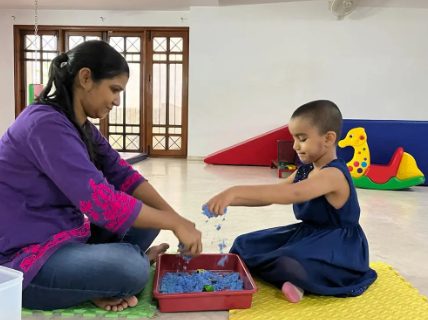
– Sensory bins with hidden objects for tactile desensitisation and hand strengthening
– Wheelbarrow walks and wall push-ups for proximal stability
None of this looks like homework. All of it is building exactly the architecture your child’s body needs.
And the OT home program for kids means parents get practical activities to reinforce all of this between sessions, turning bath time, snack time, and play time into therapeutic opportunities. (So, you were basically already an OT. You just didn’t have the title.)
How Early Autism Ventures Supports Prewriting Development
At Early Autism Ventures (EAV), we take prewriting seriously, because we know what happens when the foundation is solid. Children write more confidently, learn more easily, and feel better about themselves in the classroom.
Our occupational therapists conduct comprehensive OT assessments for children that look at the whole picture, posture, core strength, fine motor skills, grip development, visual perception, sensory processing, and motor planning. Nothing is assumed. Everything is assessed.
From there, we build an individualized therapy plan that targets your child’s specific prewriting gaps, using evidence-based techniques, play-based methods, and a deep understanding of how sensory issues in children interact with motor learning.
Our OT team works closely with our speech therapy and ABA therapy teams, because we know that a child who is regulated, communicating, and motivated learns motor skills faster. Our BCBAs use positive reinforcement to support engagement in fine motor tasks, and our ABA progress monitoring tracks every milestone, including prewriting goals.
We also provide parents with a personalized OT home program, because the work doesn’t stop when the session ends. You are your child’s most important therapist, and we make sure you feel equipped, confident, and supported.
Whether your child is 2 years old and not yet scribbling, or 7 years old and struggling to keep up in class, it is never too early, and never too late, to build the foundation they need.
Prewriting skills are invisible. Parents rarely hear about them until something goes wrong. But they are the bedrock of your child’s entire written communication journey, and building them well, early, with expert support, makes everything that follows easier.
Your child isn’t behind. They’re building. And with the right team beside them, those foundations will hold.
Let’s start building together.
Schedule Your Free Consultation with Early Autism Ventures Right Away