For parents of children with Autism Spectrum Disorder (ASD), one of the biggest concerns is communication. Whether it’s delayed speech, difficulty expressing needs, or challenges in social interaction, these hurdles can impact a child’s daily life significantly.
At Early Autism Ventures, we believe that every child deserves the ability to communicate, connect, and grow with confidence. This guide will help you understand the importance of speech therapy, what to expect, and how early intervention can transform outcomes.
Understanding Speech and Communication Challenges in Autism
Children with autism often experience:
Delayed speech development
Difficulty understanding language
Limited verbal or non-verbal communication
Challenges in social interaction
Speech therapy is not just about talking, it’s about building meaningful communication. It includes gestures, visual tools, and alternative communication systems.
Research shows that early therapy helps children express their needs better, reducing frustration and improving overall quality of life.
Why Speech Therapy is Essential for Children with Autism
Speech therapy plays a foundational role in autism intervention. It focuses on:
1. Improving Communication Skills
Children learn how to:
Form words and sentences
Understand instructions
Use language in social contexts
2. Enhancing Social Interaction
Therapists teach:
Eye contact
Turn-taking
Conversation skills
3. Reducing Behavioral Challenges
When children can communicate effectively, frustration-driven behaviors often decrease.
4. Building Independence
Communication skills help children become more self-reliant in daily life.
Studies consistently show that speech therapy significantly improves communication, social skills, and independence in children with autism.
The Power of Early Intervention
One of the most important factors in autism therapy is timing.
Early intervention (typically before age 6) can:
Improve communication skills
Enhance learning ability
Reduce behavioral challenges
Increase long-term independence
This is because a child’s brain is most adaptable during early childhood, allowing therapy to create stronger neural connections.
In fact, children who receive early therapy often show better developmental progress compared to those who start later.
Speech Therapy Techniques Used in 2026
Modern speech therapy has evolved significantly. At centers like Early Autism Ventures, therapy is personalized, evidence-based, and engaging.
1. Play-Based Therapy
Children learn through fun, structured play activities that encourage communication.
2. Augmentative and Alternative Communication (AAC)
Tools like:
Picture Exchange Communication System (PECS)
Communication boards
Speech-generating devices
These help non-verbal children express themselves effectively.
3. Social Communication Therapy
Focuses on real-life interactions such as:
Asking questions
Responding appropriately
Understanding social cues
4. Parent Training Programs
Parents are guided to continue therapy techniques at home, ensuring consistency and faster progress.
5. Multidisciplinary Approach
Speech therapy works best when combined with:
Occupational therapy
Behavioral therapy (ABA)
Special education
Signs Your Child May Need Speech Therapy
If you’re in HSR Layout and wondering whether your child needs help, look out for these signs:
Not speaking by age 2
Limited eye contact
Difficulty following simple instructions
Repetitive speech or no speech
Trouble interacting with others
Early support can begin even before a formal diagnosis—waiting can delay progress.
What to Expect from Speech Therapy at Early Autism Ventures
When you choose Early Autism Ventures in HSR Layout, you can expect:
1. Comprehensive Assessment
Each child undergoes a detailed evaluation to understand:
Strengths
Challenges
Communication level
2. Customized Therapy Plans
No two children are the same. Therapy is tailored to individual needs.
3. One-on-One Sessions
Focused attention ensures better learning and faster improvement.
4. Progress Tracking
Regular assessments help measure improvement and adjust strategies.
5. Parent Involvement
You’re an active part of your child’s journey.
Why Choose Speech Therapy Services in HSR Layout?
HSR Layout has become a hub for quality therapy services due to:
Accessibility for Bangalore residents
Availability of trained therapists
Growing awareness of autism intervention
Choosing a nearby therapy center ensures:
Consistency in sessions
Reduced travel stress for children
Better parent participation
Benefits of Speech Therapy for Autism
Here’s what parents often notice after consistent therapy:
Improved speech and language skills
Better understanding of instructions
Increased social interaction
Reduced meltdowns and frustration
Greater confidence and independence
Early and consistent therapy can even lead to long-term improvements in learning and communication abilities.
The Future of Autism Therapy (2026 and Beyond)
The landscape of autism therapy is evolving with:
AI-assisted communication tools
Digital therapy platforms
Data-driven personalized therapy plans
Increased awareness and early screening programs
Recent initiatives in India are also focusing on early identification and multidisciplinary care, highlighting the importance of timely intervention.
How to Get Started
If you’re searching for speech therapy services in HSR Layout for children with autism, the best time to start is now.
For parents of children with Autism Spectrum Disorder (ASD), communication challenges can be one of the most difficult aspects to navigate. Speech delays, difficulty expressing needs, or limited social interaction often create barriers in a child’s development.
If you’re searching for speech therapy services in J.P. Nagar for autism child, you’re already taking a crucial first step. Early and structured speech therapy can significantly improve communication, independence, and overall quality of life.
At Early Autism Ventures, our speech therapy programme is designed to provide individualized, evidence-based support tailored to each child’s needs—helping them communicate, connect, and thrive.
Understanding Autism and Speech Challenges
Autism is a neurodevelopmental condition that affects communication, behavior, and social interaction. Many children with autism experience:
Delayed speech or no speech
Difficulty understanding language
Repetitive or unusual speech patterns
Challenges in social communication
Research shows that speech and language differences are central to autism and often appear early in development, making early intervention critical.
Why Speech Therapy is Essential for Autism
Speech therapy is one of the most important interventions for children with autism. It focuses on improving both verbal and non-verbal communication.
Key Benefits
Improved Communication Skills Helps children express needs, emotions, and thoughts clearly
Better Social Interaction Teaches conversation skills, turn-taking, and understanding emotions
Increased Independence Children learn to communicate without frustration
Enhanced Confidence Communication leads to better participation in school and daily life
According to global research, speech and language therapy improves understanding and use of communication in children with autism.
Importance of Early Intervention (2026 Insights)
One of the biggest medically backed truths in autism care is this: earlier therapy = better outcomes.
Early intervention improves language and social skills significantly
It reduces behavioral challenges and enhances learning ability
Starting therapy before age 5 increases chances of language development
In fact, studies show that children receiving early therapy demonstrate better communication, higher independence, and improved long-term outcomes.
Techniques Used in Speech Therapy for Autism
Modern speech therapy combines traditional methods with evidence-based and technology-supported approaches.
1. Augmentative and Alternative Communication (AAC)
Tools like picture boards, apps, and devices help non-verbal children communicate.
2. Play-Based Therapy
Learning through play enhances engagement and natural communication.
3. Social Communication Training
Focuses on real-life interactions like greetings, conversations, and emotional understanding.
4. Visual Supports
Charts, flashcards, and routines improve comprehension.
5. Parent-Integrated Therapy
Parents are trained to reinforce communication at home—proven to improve outcomes.
Speech Therapy + ABA: A Powerful Combination
Many children benefit from a combination of speech therapy and ABA therapy.
Speech therapy improves communication
ABA therapy improves behavior and learning readiness
Together, they create a structured and holistic intervention plan. Research confirms that combining therapies leads to better communication outcomes.
Why Choose Speech Therapy Services in J.P. Nagar
J.P. Nagar has become a growing hub for specialized autism care due to:
Access to trained therapists
Structured therapy programs
Parent-friendly centers
Integrated services (Speech + ABA + OT)
However, not all centers provide individualized, evidence-based care—which is where Early Autism Ventures stands out.
Early Autism Ventures – Speech Therapy That Makes a Difference
At Early Autism Ventures, our speech therapy services in J.P. Nagar are designed with one core principle: every child is unique.
What Makes Our Programme Different
1. Individualized Therapy Plans
Every child receives a customized communication plan based on their abilities.
2. Evidence-Based Approach
We use proven techniques like AAC, naturalistic interventions, and social communication training.
3. Integration with ABA Therapy
Our speech therapists collaborate with ABA professionals for better outcomes.
4. Parent Training & Involvement
We empower parents with tools to continue therapy at home.
5. Focus on Functional Communication
We don’t just teach words—we teach children how to use communication in real life.
Signs Your Child May Need Speech Therapy
If you notice any of the following, it may be time to seek help:
Not speaking by expected age
Limited eye contact
Difficulty understanding instructions
Repetitive speech patterns
Trouble expressing needs
Early diagnosis and intervention can dramatically change outcomes.
What to Expect in Speech Therapy Sessions
When you enroll your child in speech therapy at Early Autism Ventures, you can expect:
Assessment & Goal Setting
Structured Therapy Sessions
Play-Based Learning Activities
Progress Tracking & Reporting
Parental Guidance Sessions
Consistency and collaboration are key to success.
Results You Can Expect
While every child progresses differently, consistent speech therapy can lead to:
First words or improved vocabulary
Better sentence formation
Improved social interaction
Reduced frustration and tantrums
Increased independence
Studies confirm that speech interventions significantly improve language outcomes in children with autism.
How to Choose the Right Speech Therapy Centre in J.P. Nagar
Before selecting a center, consider:
Qualifications of therapists
Therapy approach used
Parent involvement
Progress tracking methods
Integration with other therapies
Early Autism Ventures meets all these criteria with a structured, child-centric model.
Conclusion
Finding the right speech therapy services in J.P. Nagar for autism child can transform your child’s life. With the right support, children with autism can develop meaningful communication skills, build relationships, and lead more independent lives.
At Early Autism Ventures, we combine science, compassion, and personalized care to help every child reach their full potential.
If you’re looking for expert guidance and proven results, our speech therapy programme is designed to support your child every step of the way.
Picture this: Your child has something important to say, but the words feel stuck behind an invisible wall.
As a parent, you want nothing more than to hear their thoughts, dreams, and even their complaints about broccoli. If your child has autism, you’re not alone in this journey, and there’s incredible hope ahead.
The Reality of Autism and Communication Today
The numbers tell a powerful story. In India,Autism Spectrum Disorder (ASD) is estimated to affect approximately 1 in 68 children, accounting for about 1.12% to 1.5% of children between the ages of 2 and 9. Some estimates suggest that up to 3% of the overall population may be on the autism spectrum.
The rising number of autism diagnoses in India does not necessarily indicate a surge in the actual prevalence of Autism Spectrum Disorder (ASD). Instead, it reflects growing awareness, better access to screening tools, and broader diagnostic criteria.
As a result, more individuals, especially those who may have been previously overlooked or misdiagnosed, are now being accurately identified. What this truly signifies is progress: more families are receiving the support, recognition, and early intervention they need, leading to improved outcomes and a stronger foundation for lifelong development.
Communication challenges affect nearly every child with autism spectrum disorder (ASD), but here’s the beautiful truth: every child has a voice waiting to be discovered.
Some children will speak in full sentences, others will paint their thoughts through pictures, and some will find their voice through technology. The goal isn’t to make every child communicate the same way; it’s to help them find their unique way to connect with the world.
Understanding Communication Problems in Children with Autism
Children with autism face various communication hurdles that can feel overwhelming for families. These challenges might include:
Verbal communication difficulties can range from delayed speech development to trouble with conversation flow. Some children might repeat phrases they’ve heard (called echolalia), while others might struggle to find the right words when they need them most.
Nonverbal communication puzzles often involve difficulty reading facial expressions, understanding body language, or using gestures effectively. Your child may not naturally wave goodbye or may miss the subtle social cues that seem obvious to others.
Social communication barriers can make it hard for children to engage in back-and-forth conversations, ask for help when needed, or express their emotions appropriately. They might want to connect but feel lost in the social dance of communication.
Think of it like having a brilliant radio station that’s just slightly off the right frequency – the content is right there, but the signal needs fine-tuning to come through clearly.
What is Speech Therapy for Autism?
Speech therapy for children with autism is a specialized form of intervention that helps improve a child’s communication skills—both verbal and non-verbal. Since many children on the autism spectrum face challenges with language, speech, and social interaction, speech therapy plays a key role in helping them express themselves, understand others, and build meaningful connections. Here’s how this therapeutic approach transforms lives:
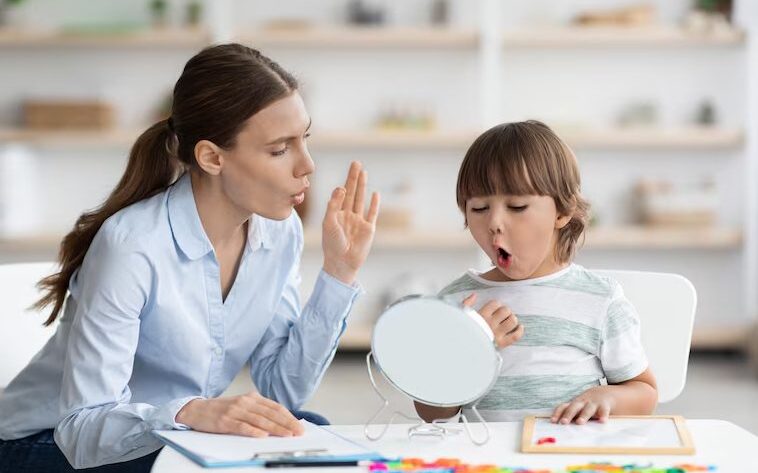
Building Core Communication Skills: Speech-language pathologists work with children to develop fundamental communication abilities. They help children understand that communication is a two-way street, where thoughts and feelings flow in both directions. Through targeted activities and play-based learning, children discover that their voice matters and that others want to hear what they have to say.
Developing Language Understanding: Many children with autism are visual learners who benefit from seeing concepts rather than just hearing them. Speech therapists use picture cards, visual schedules, and interactive games to help children connect words with meanings. They might use a child’s special interest in trains to teach prepositions (“The train goes under the bridge”) or emotions (“The passengers look happy”).
Enhancing Social Communication: This is where the real magic happens. Speech therapy helps children learn the unspoken rules of conversation – like taking turns, staying on topic, and reading social cues. Children practice these skills in safe, supportive environments where mistakes are viewed as learning opportunities rather than failures.
Alternative Communication Methods: For children who struggle with verbal communication, speech therapists introduce alternative and augmentative communication (AAC) systems. These might include picture exchange systems, sign language, or high-tech communication devices. The goal is always the same: helping every child find their voice, whatever form it takes.
The Foundation for Communication and Feeding
Every parent’s biggest desire is to see their children speak. If we dive a little deeper, what we are all looking for is to understand how our children communicate, what they are thinking, and so much more.
Most children on the autism spectrum get dismissed by saying that they don’t want to talk, but actually, they have difficulty with the whole process of speech.
The Role of Sensory-Motor Integration in Speech and Feeding
Before a child can speak clearly or eat safely, their body needs to know how to move.
Sensory-motor skills—like jaw stability, tongue movement, and breath control—are the building blocks for both communication and feeding. Many children with autism experience challenges in these areas, which can impact how they chew, swallow, or produce sounds.
That’s why at Early Autism Ventures, we integrate sensory-motor strategies into our speech and feeding programs, helping children feel more in control of their bodies so they can find their voice and enjoy mealtimes with confidence.
The Role of ABA Therapy in Communication Development
Does ABA Support Speech Development for Children on the Spectrum?
ABA therapy uses positive reinforcement to encourage communication attempts. When a child makes an effort to communicate, whether through words, gestures, or pictures, they receive immediate, meaningful rewards. This approach helps children understand that communication is valuable and worth the effort.
Generalization of Skills: One of ABA therapy’s greatest strengths is helping children use their new communication skills in different settings. A child might learn to request their favorite snack during therapy and then practice this skill at home, school, and in the community. This generalization ensures that communication improvements extend beyond the therapy room.
Recent research indicates that around 36.5% of autism caregivers utilize ABA therapy, with the majority reporting positive results in their children’s communication development.
Behavioral Support for Communication: Sometimes, challenging behaviors occur when children can’t express their needs effectively. ABA therapy helps identify these communication breakdowns and teaches children appropriate ways to get their message across. When children have better communication tools, problem behaviors often decrease naturally.
Here’s how you can implement simple tips for improving your autistic child’s communication skills, even at home:
Creating a Communication-Rich Environment at Home: Parents play the most crucial role in their child’s communication journey. Here are practical strategies that make a real difference:
Follow Your Child’s Lead: Pay attention to what captures your child’s interest and use those moments as communication opportunities. If they’re fascinated by spinning wheels, talk about round objects, movement, and colors. Their interests become bridges to broader communication.
Narrate Your Day: In simple words: become a friendly sports commentator for daily activities. “Now we’re putting on socks. The socks are blue. They keep our feet warm.” This constant narration gives children language models for everyday experiences.
Create Communication Opportunities: Instead of anticipating every need, create gentle opportunities for your child to communicate. Keep favorite snacks in sight but out of reach, pause during favorite songs, or “forget” to give them their spoon at dinner. These moments encourage communication attempts.
Celebrate All Communication: Whether your child points uses a single word, or creates a full sentence, celebrate every communication attempt. Your enthusiasm shows them that their efforts to connect are valued and important.
The Technology Revolution in Autism Communication
We’re living in an exciting time for autism communication support. High-tech AAC devices can now predict words, learn individual communication patterns, and even help children practice conversations with virtual partners. Voice output devices give children immediate feedback and help them hear their own communication attempts.
Apps designed specifically for autism communication continue to evolve, offering everything from visual schedules to emotion identification games. These tools don’t replace human connection but enhance it by giving children more ways to express themselves.
Research consistently shows that early intervention produces the best outcomes for children with autism. Thebrain’s plasticity during early childhood means that communication pathways can be strengthened and new connections formed more easily.
Children who receive speech therapy and ABA services before age 5 typically show greater improvements in communication skills.
The key is starting where your child is and building from there. Some children might begin with basic cause-and-effect communication, while others might work on complex conversation skills. Plus, every child’s journey is unique, and progress should be measured against their own starting point, not compared to other children.
Signs Your Child Might Benefit from Speech Therapy
While every child develops at their own pace, certain signs suggest that professional speech therapy could be beneficial:
Limited vocabulary for their age
Difficulty following simple instructions
Trouble expressing basic needs or wants
Challenges with social interaction and play
Repetitive speech patterns or echolalia
Difficulty understanding abstract concepts
Problems with conversation skills
The most effective communication intervention involves a team approach. Speech therapists, ABA therapists, occupational therapists, teachers, and families work together to create consistent communication expectations and opportunities across all environments.
This collaboration ensures that children practice their communication skills throughout their day, not just during therapy sessions. When everyone uses similar strategies and celebrates the same goals, children make faster progress and feel more confident in their communication abilities.
Every child with autism has the potential for communication growth. Some children will become confident speakers, others will master sophisticated AAC systems, and many will develop their own unique communication style that perfectly fits their needs and personality.
The journey isn’t always linear. There will be breakthrough moments that make you cry happy tears and challenging days that test your patience. But with consistent support, evidence-based interventions, and belief in your child’s potential, progress happens.
How Early Autism Ventures Can Transform Your Child’s Communication Journey
At Early Autism Ventures (EAV), we understand that every child’s communication journey is unique, and we’re here to walk alongside your family every step of the way. Our comprehensive approach combines the latest research in speech therapy and ABA techniques with the warmth and understanding that families deserve.
Our team of certified speech-language pathologists and Board-Certified Behavior Analysts work collaboratively to create individualized treatment plans that address your child’s specific communication needs.
We don’t believe in one-size-fits-all solutions because we know your child isn’t one-size-fits-all!
We pride ourselves on making therapy feel like play, learning feels like fun, and progress feels achievable. Our modern facilities are designed to be welcoming spaces where children feel safe to take communication risks and celebrate their successes.
Most importantly, we believe in empowering families with knowledge, strategies, and confidence. We provide ongoing support and training so you can continue fostering your child’s communication development at home and in the community.
Ready to Help Your Child Find Their Voice?
Your child’s communication journey starts with a single step, and we’re here to take that step with you. Everyday you wait is another day your child could be building confidence, making connections, and discovering the joy of being understood.
Recent Comments