

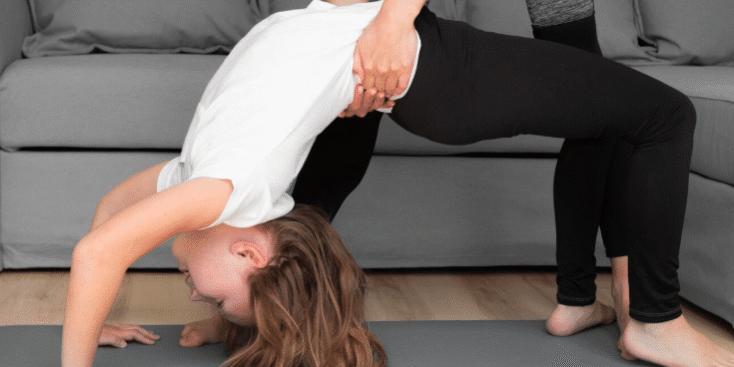
Your child is doing homework, and within five minutes, they’ve slid halfway off the chair. One elbow is propping up their head, one leg is tucked under them, and the pencil grip has gone from textbook perfect to a fist around a crayon.
You say “sit up,” they sit up, and thirty seconds later, they’re back in the same slump. It’s not defiance. It’s not laziness.
More often than not, it’s a core that’s working overtime just to keep them upright, with nothing left over for handwriting, attention, or sitting still.
Parents rarely think about core muscles until something else goes wrong first, like messy handwriting, clumsiness, or a teacher’s note about poor attention in class. But underneath a surprising number of these everyday struggles is something simpler: postural control, the body’s ability to hold itself steady against gravity while doing something else. It’s easy to overlook because it’s invisible.
Nobody diagnoses a child with a “weak core.” But occupational therapists see it constantly, especially in children with autism, sensory processing differences, or other neurodevelopmental conditions.
What core strength and postural control actually mean
Postural control is the brain and body working together to keep a child balanced and upright, whether they’re sitting at a desk, standing in a line, or reaching for a toy on a shelf.
It relies on three systems talking to each other: the vestibular system (balance, movement through space), the proprioceptive system (body awareness, where limbs are without looking), and the visual system.
Core muscles, the deep abdominal, back, and pelvic muscles, are the physical anchor that lets this whole system function without constant conscious effort.
Here’s why this matters more than it sounds like it should: proximal stability enables distal mobility. In plain terms, a stable trunk is what lets the hands and fingers do precise, controlled work. Fine motor skills like handwriting, buttoning a shirt, or using scissors don’t develop in isolation. They sit on top of a strong core.
Research consistently links gross motor skill development in early childhood to better self-regulation, attention, and executive function down the line, which is exactly why a “posture problem” so often shows up looking like a focus problem instead.
This connection is even tighter for children with autism spectrum disorder. A systematic review and meta-analysis published in the Journal of Autism and Developmental Disorders found large, consistent differences in standing postural control between children with autism and their neurotypical peers, pointing to underlying differences in how sensory information is processed and used for balance.
A related clinical review notes that these postural differences often appear in infancy and persist into later childhood, and can limit a child’s opportunities to build other motor and social skills on top of that foundation.
Signs your child’s core and postural control might need support
Some of these are easy to write off as habits or personality quirks. On their own, none of them are alarming. Together, or if they persist past the age most children outgrow them, they’re worth a closer look.
- Slumping, slouching, or sliding off chairs during seated activities
- Leaning on a wall, desk, or another person instead of sitting or standing independently
- W-sitting (sitting with knees bent and feet out to the sides) as a default floor position
- Tiring quickly during physical play, or avoiding climbing, running, and playground equipment
- Poor pencil grip, heavy pressure when writing, or handwriting that gets worse as a task goes on
- Frequent bumping into furniture, tripping, or general clumsiness
- Difficulty with activities that need both sides of the body to work together, like pedaling a bike or catching a ball
- Appearing “floppy” when picked up, or needing extra support to sit unassisted past the expected age
If your child is consistently missing physical milestones for their age, these developmental milestone checklists are a useful, free starting point before a formal evaluation.
Why this happens: causes worth understanding, not worrying over
There isn’t one single cause, and in most cases, it’s not something a parent did or didn’t do.
Low muscle tone (hypotonia)
Some children are simply born with looser muscle tone, which makes sustained postural work more effortful. This is common in children with autism and other neurodevelopmental conditions.
Sensory processing differences
When the vestibular or proprioceptive systems send unclear signals about balance and body position, the brain has a harder time automating posture, so the child has to consciously work at something that should be background processing.
Reduced prone (tummy time) play in infancy
Less floor time in early infancy can mean fewer early opportunities to build the shoulder, neck, and trunk strength that later supports sitting and writing.
Sedentary habits and screen time
More time sitting, less time climbing, crawling, and free play, means fewer natural reps of the movements that build core strength.
Prematurity or co-occurring medical conditions
Some children start a little behind on physical development for reasons entirely outside anyone’s control, and simply need targeted, patient support to close that gap.
Not sure if it’s a phase or something to look into? Talk to our team.
The Therapy That Actually Helps: Pediatric Occupational Therapy
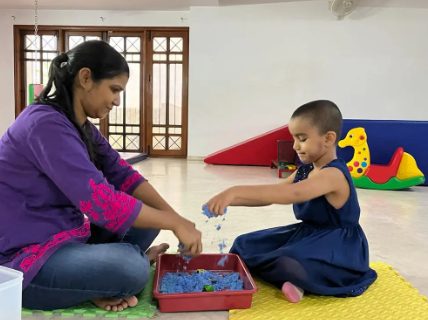
This is squarely occupational therapy territory, and specifically, sensory integration therapy combined with gross motor skills therapy.
Sensory integration therapy works directly on how the brain processes vestibular and proprioceptive input, using swings, balance beams, therapy balls, and weighted or resistance-based activities to help a child’s nervous system organize movement information more efficiently.
For children with autism, where sensory processing differences and postural instability are so closely linked, this isn’t a “nice to have.” It’s often foundational.
Gross motor skills therapy and balance and coordination therapy build strength and stability through play, think obstacle courses, animal walks, core-strengthening games, rather than repetitive drills a child will resist.
This is where motor planning activities come in too, helping a child sequence and execute movements (climb, twist, reach, catch) that require multiple muscle groups to cooperate.
Fine motor and handwriting improvement therapy rounds it out. Once trunk stability improves, occupational therapists layer in hand strengthening and pencil control work, because a stable base makes fine motor gains stick.
A quick example: one child came to us barely able to sit through a ten-minute table activity without sliding out of the chair, and handwriting was a daily battle at home and school.
We started with a thorough OT assessment for children to map out exactly where the gaps were, then built a plan around gross motor play, weighted lap pads, and short bursts of core-focused movement before seated tasks.
Within a few months, seated tolerance had roughly doubled, and letter formation became noticeably more consistent, not because we drilled handwriting harder, but because the foundation underneath it got stronger.
Talk to our therapists about what your child’s posture might be telling you.
At Early Autism Ventures, postural and core-strength concerns are addressed through pediatric occupational therapy built around each child, not a generic circuit.
Every child starts with a proper OT assessment for children that looks at muscle tone, sensory processing, balance, and functional skills like sitting, transitions, and self-care, because posture never shows up in isolation from the rest of a child’s day.
From there, therapy blends sensory integration therapy, movement-based gross motor work, and, where relevant, ADL training, since core strength quietly underpins things like getting dressed, sitting for meals, and managing a school bag.
For children whose sensory or attention needs intersect with behaviour goals, our occupational therapists in Bangalore and Hyderabad, coordinate closely with our ABA and speech colleagues, so a child working on sitting tolerance in OT also gets consistent support across therapy sessions and at home.
We also send home simple, low-pressure OT home program activities (a wheelbarrow walk here, an animal crawl race there) because ten minutes of movement woven into a normal evening does more for a developing core than a single weekly session ever could.
One parent told us, quietly, after a few months of therapy, that she’d stopped dreading school pickup because the teacher had stopped mentioning the slumping and the “can’t sit still” comments.
She said it was the first time in a year she felt like she was watching her son catch up instead of fall behind. That’s the part that doesn’t show up in progress notes, but it’s the part that matters most.
See how a personalised OT plan could support your child’s posture and progress.
Postural milestones at a glance
| Age range | What most children can typically do | Consider an OT evaluation if… |
|---|---|---|
| 6–12 months | Sits without support, pushes up on hands during tummy time | Child cannot sit unsupported by 9 months |
| 1–2 years | Stands and walks independently, squats to pick up toys | Frequent falling, avoids weight-bearing on legs |
| 3–4 years | Balances on one foot briefly, climbs playground equipment | Tires quickly, avoids climbing or running |
| 5–6 years | Sits upright at a desk for short tasks, rides a tricycle or bicycle with training wheels | Constant slumping, W-sitting as default, poor pencil control |
| 7+ years | Sustains seated posture through a class period, coordinates both sides of body for sports | Ongoing handwriting fatigue, clumsiness, avoidance of PE |
Ranges adapted from CDC-AAP evidence-informed developmental milestones, 2022.
If something feels off, trust that instinct
You don’t need a diagnosis in hand to ask for an evaluation. If your child’s posture, balance, or stamina for everyday tasks feels like more effort than it should be, that’s reason enough to get a professional opinion.
Early support, especially in the preschool and early school years, gives a developing core the best chance to catch up before slumping becomes a habit and handwriting becomes a source of daily frustration.